Author: Md. Hamidur Rahman (Marine Engineer, Permaculturist)
Table of Contents
- Introduction: Ancient Wisdom for Sustainable Design
- A City Designed Like a Living System
- Relative Placement: The Genius Behind Sustainability
- Strategic Placement: Where Nature Meets Economy
- Zoning at Scale: A Proto-Permaculture City
- Understanding the City Through Layers
- From Geometry to Life
- A Permaculture Perspective
- Lessons for Modern Sustainable Design
- Reflection
- References
Ancient Wisdom for Sustainable Design
When Caliph Al-Mansur envisioned Madinat as-Salam—the “City of Peace”—in 762 CE, he wasn’t merely founding a capital. He was designing a living system. Known as Baghdad’s original “Round City,” this remarkable example of early urban planning reflects principles that modern permaculture would later articulate: relative placement, zoning, efficiency, and resilience.
A City Designed Like a Living System
The Round City was not a product of organic, unplanned growth—it was a deliberate and thoughtful design.
Its circular form symbolized unity and control, but beyond symbolism, it functioned as an integrated system. At its core stood the Great Mosque and the Caliph’s palace, forming the spiritual and political nucleus. From this center, the city expanded outward in carefully structured layers—each serving a distinct purpose.
This mirrors permaculture zoning, where elements are arranged based on frequency of use and level of care, creating systems that are both efficient and sustainable.
Relative Placement: The Genius Behind Sustainability
Permaculture teaches that a system thrives when elements are positioned in relation to one another to minimize effort and maximize productivity.
Al-Mansur’s design exemplified this principle:
- Central Zone (Zone 0 equivalent)
The mosque and palace formed the core—ensuring that governance, spirituality, and daily life remained interconnected and easily accessible. - Inner Ring (High-Interaction Zone)
Administrative offices, guards, and elite residences were placed close to the center, enabling efficient governance and rapid communication. - Outer Residential Zone
Markets, homes, and everyday activities were distributed further outward, balancing accessibility with spatial organization. - Perimeter & Gates (Edge Zones)
The outer walls and gates connected the city to regional trade routes, functioning as dynamic edges—zones of exchange, movement, and productivity.
This arrangement reduced unnecessary movement, strengthened relationships between functions, and created a system that sustained itself with minimal friction.
Strategic Placement: Where Nature Meets Econom
The success of Madinat as-Salam was not only architectural—it was ecological and economic.
- Control of Trade Routes
Positioned along the Tigris River, the city became a critical node connecting East and West, facilitating commerce and cultural exchange. - Water Security
Access to the river ensured a reliable water supply for agriculture, sanitation, and daily life—an essential foundation for long-term sustainability.
In permaculture terms, this reflects a core idea:
– work with natural systems, not against them
Zoning at Scale: A Proto-Permaculture City
What makes the Round City extraordinary is that it applied zoning not at the scale of a garden or household, but across an entire metropolis.
Permaculture zones typically include:
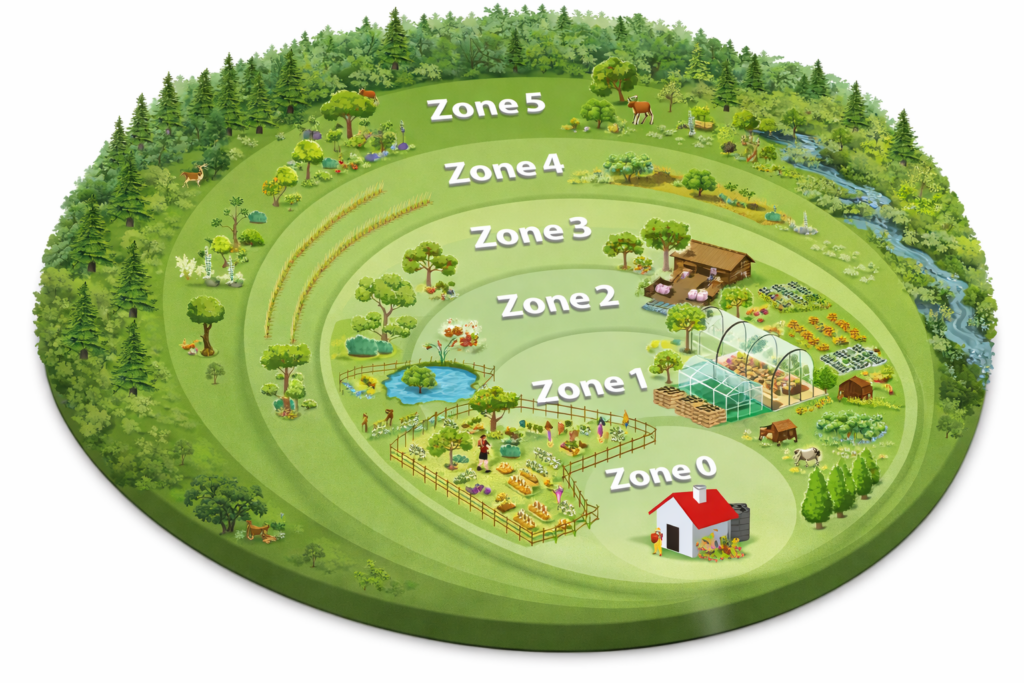
- Zone 0: Home
- Zone 1: Daily-use spaces
- Zone 2–3: Production areas
- Zone 4–5: Semi-wild and natural systems
Al-Mansur’s design aligns closely with this framework:
- Core (Palace & Mosque) → constant use
- Inner rings → frequent interaction
- Outer rings → residential and economic life
- Beyond the walls → agriculture, trade routes, and natural landscapes
This represents systems thinking centuries ahead of its time.
️Understanding the City Through Layers
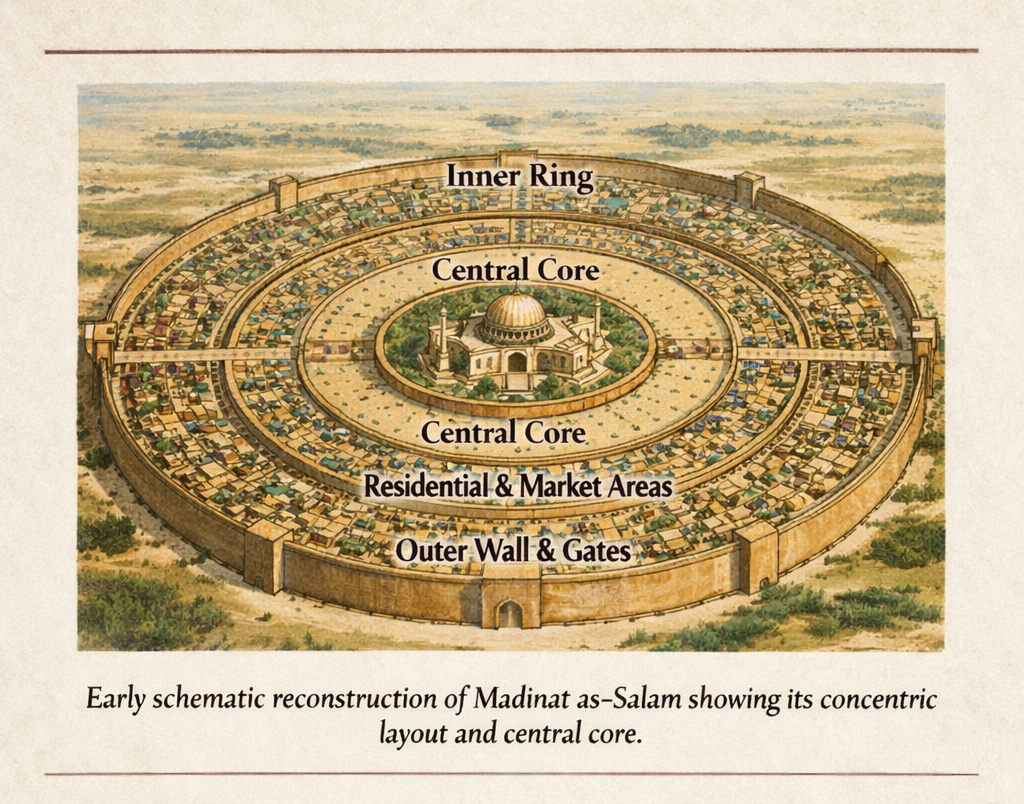
The original plan reveals a highly structured urban form centered around purpose. The Caliph’s palace and the Great Mosque occupy the heart, surrounded by a controlled inner ring for administration and elite functions. Beyond this, successive rings support residential life, circulation, and defense—all enclosed within fortified walls.
This layout reflects a powerful principle:
– function determines placement
Each layer serves a defined role, minimizing inefficiency and reinforcing order—an approach later formalized in permaculture as zoning.
️From Geometry to Life
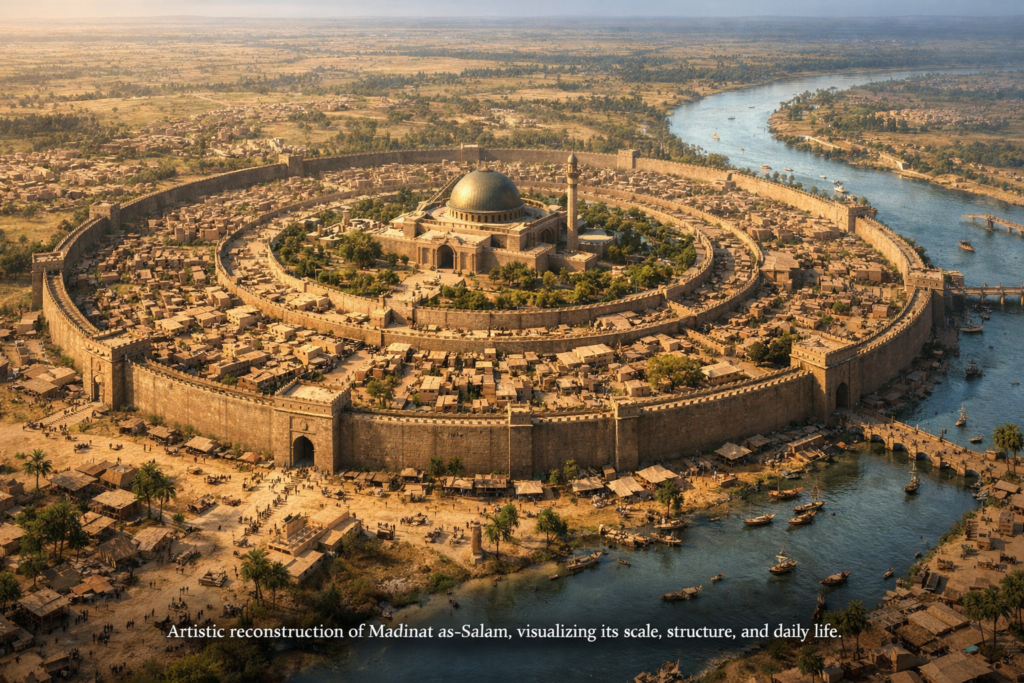
Viewed in three dimensions, the city transforms from a diagram into a living organism.
The central dome rises as a focal point, surrounded by layered neighborhoods that pulse with activity. Walls and gates connect the city to trade networks, while the nearby river integrates the urban form with its natural environment.
This was not merely a place to live—it was a dynamic system, where governance, economy, and daily life were seamlessly interwoven.
A Permaculture Perspective
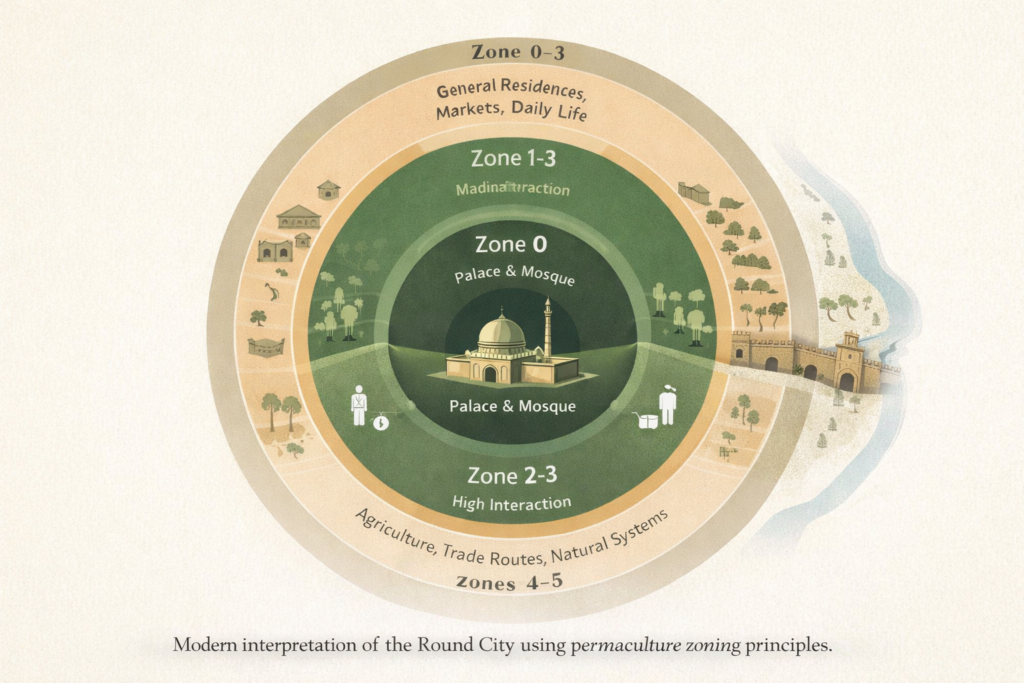
Through a permaculture lens, the Round City reveals a strikingly familiar structure:
- Zone 0 (Core): Palace & Mosque → constant use
- Zone 1: Governance, guards, close residences → high interaction
- Zone 2–3: General residences, markets, daily life
- Zone 4–5 (Outside walls): Agriculture, trade routes, natural systems
This reinterpretation highlights a timeless principle:
– place elements according to frequency of use and necessity
Lessons for Modern Sustainable Design
In an era where cities face congestion, inefficiency, and environmental strain, the Round City offers enduring lessons:
- Design for proximity → reduces energy and time
- Align with natural systems → enhances resilience
- Layer functions thoughtfully → increases productivity
- Create meaningful centers → strengthens community
Sustainability is not about complexity—it is about clarity of placement and purpose.
Reflection
Looking at Madinat as-Salam through both historical and ecological lenses reveals a powerful truth:
Sustainability is not a new concept—it is a rediscovery.
The Round City demonstrates how thoughtful design—rooted in relationship, context, and human need—can produce systems that are efficient, resilient, and harmonious.
Whether designing a garden, a neighborhood, or an entire city, the principle remains constant:
right element, right place, right relationship.
When this alignment is achieved, sustainability is no longer an effort—it becomes a natural outcome.
References
- Al-Tabari, History of the Prophets and Kings (9th century)
- Al-Ya‘qubi, Tarikh al-Ya‘qubi
- Kennedy, Hugh. When Baghdad Ruled the Muslim World (2005)
- Le Strange, Guy. Baghdad During the Abbasid Caliphate (1900)
- Mollison, Bill. Permaculture: A Designer’s Manual
- Holmgren, David. Permaculture Principles and Pathways Beyond Sustainability
- Encyclopaedia Britannica — Round City of Baghdad