
Author: Tasnim Tarannum (HRM Lecturer, North South University)
The soil beneath our feet is not merely a physical foundation; it is a profound source of life, provision, and blessing. For many urban dwellers, it may be difficult to fully comprehend the struggles of farmers who labor under the sun and in the rain to sustain entire populations. Despite their tireless efforts, their work can be undone by a single storm. Agriculture, therefore, is not merely a form of manual labor; it represents a deeper spiritual relationship between human effort and divine provision.
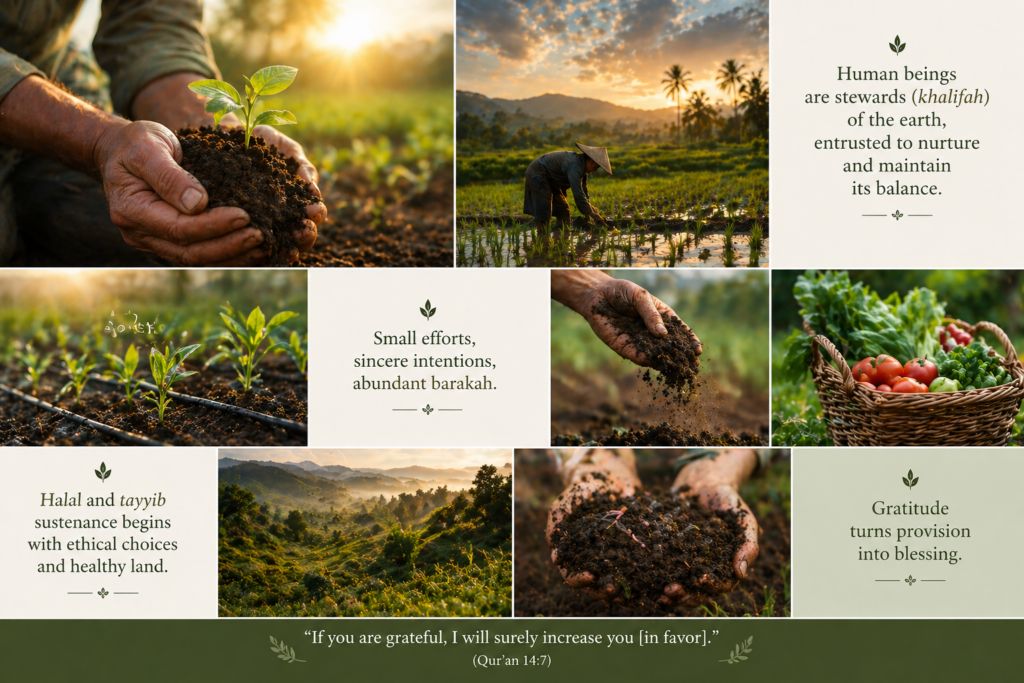
In Islam, this concept is closely tied to barakah—a form of divine blessing that brings abundance beyond material measure. Even small and sincere efforts can yield immense returns when accompanied by the right intention. When individuals strive—by sowing seeds and nurturing crops—Allah grants blessings that transform modest yields into sufficiency. Thus, agriculture becomes not only an economic activity but also a spiritual endeavor rooted in faith and reliance on the Divine.
Human beings have been appointed as stewards (khalifah) on Earth. As stated in the Qur’an, “And it is He who has made you successors upon the earth” (Qur’an 6:165), this role entails a moral responsibility to preserve, nurture, and maintain balance within the natural world. Soil, as a fundamental natural resource, must therefore be treated as an amanah (trust) from Allah. Numerous Qur’anic verses emphasize the role of the earth as a source of sustenance for all living beings, underscoring both its generosity and the obligation to protect it from corruption and waste.
From an environmental perspective, soil is a dynamic and living system. It consists of organic matter, minerals, gases, and a vast diversity of microorganisms. Beyond serving as a medium for plant growth, soil plays a crucial role in regulating water cycles, supporting biodiversity, and stabilizing the Earth’s climate. The health of soil directly influences the vitality of ecosystems. When its structure is disrupted—through erosion, contamination, or overexploitation—the consequences extend to diminished agricultural productivity and ecological imbalance.
Islamic teachings further emphasize the consumption of halal and tayyib (pure and wholesome) food. Such food should be cultivated and harvested without harmful chemicals, unethical practices, or environmental degradation. Ethical sourcing also requires avoiding animal cruelty and the exploitation of human labor. In this sense, farming practices are not merely technical decisions but moral choices that influence both worldly outcomes and spiritual accountability. Maintaining integrity in these practices is essential for attaining barakah and spiritual reward.
However, contemporary agricultural practices in the twenty-first century often diverge significantly from these principles. Industrial farming methods, characterized by heavy machinery, deforestation, and the extensive use of synthetic fertilizers and pesticides, have contributed to soil degradation, water pollution, and biodiversity loss. These practices, while increasing short-term yields, frequently undermine long-term sustainability. Moreover, modern agriculture is a significant contributor to climate change, particularly through emissions of methane and nitrous oxide associated with large-scale farming systems.
At a global scale, these challenges are reflected in persistent food insecurity. According to recent reports, millions of people continue to face acute hunger despite significant increases in global food production. This paradox highlights that abundance in output does not necessarily translate into equitable distribution or true sufficiency. Factors such as rising food prices, environmental degradation, and geopolitical conflicts continue to exacerbate the global food crisis.
In light of these realities, it is imperative to re-evaluate agricultural practices through both ecological and spiritual lenses. Sustainable approaches—such as organic farming, permaculture, and regenerative agriculture—offer viable pathways to restore soil health while maintaining productivity. These methods align closely with Islamic principles of balance, stewardship, and moderation. By reducing pollution, conserving resources, and prioritizing ethical practices, it is possible to cultivate food systems that are both environmentally sustainable and spiritually meaningful.
Ultimately, it is essential to recognize Allah as the ultimate provider of sustenance. Adopting a mindset of gratitude and humility transforms agriculture from a purely material pursuit into an act of worship. The Qur’an reminds believers that gratitude leads to increase; thus, acknowledging divine provision not only strengthens faith but also fosters a deeper sense of contentment and responsibility. Through conscious effort, ethical practice, and spiritual awareness, the cultivation of the land can once again become a source of both nourishment and barakah.
References
Hatay, N. (2022). Soil, a living system. Biome Makers. https://biomemakers.com/blog/soil-a-living-system
Dahlal, N. M., & Ahmad, F. A. (2019). Beyond halal in food products: Present and future of halalan tayyiban. Review of Integrative Business and Economics Research, 7(2).
Naz, R. (2025). Pakistan Agriculture Research (PAR). https://par.com.pk/blogs-details/687a3458db8adc90ee3ca5f8
Food and Agriculture Organization. (2022). Agricultural production statistics.
UNICEF. (2025). The State of Food Security and Nutrition in the World 2025.
World Food Programme. (2026). A global food crisis. https://www.wfp.org/global-hunger-crisis