
Author: Tasnim Tarannum
(HRM Lecturer, North South University)
Author’s Note
This article does not present Wabi-Sabi as an alternative to, or equal to, Islam. Rather, it reflects on how some observations within the Japanese aesthetic of Wabi-Sabi resonate with values that Islam has already taught through the Qur’an and Sunnah, such as simplicity, gratitude, moderation, and contentment. Wherever there is harmony with Islamic teachings, we may appreciate it through an Islamic lens while recognizing that our creed, worship, and complete worldview are derived solely from Islam.
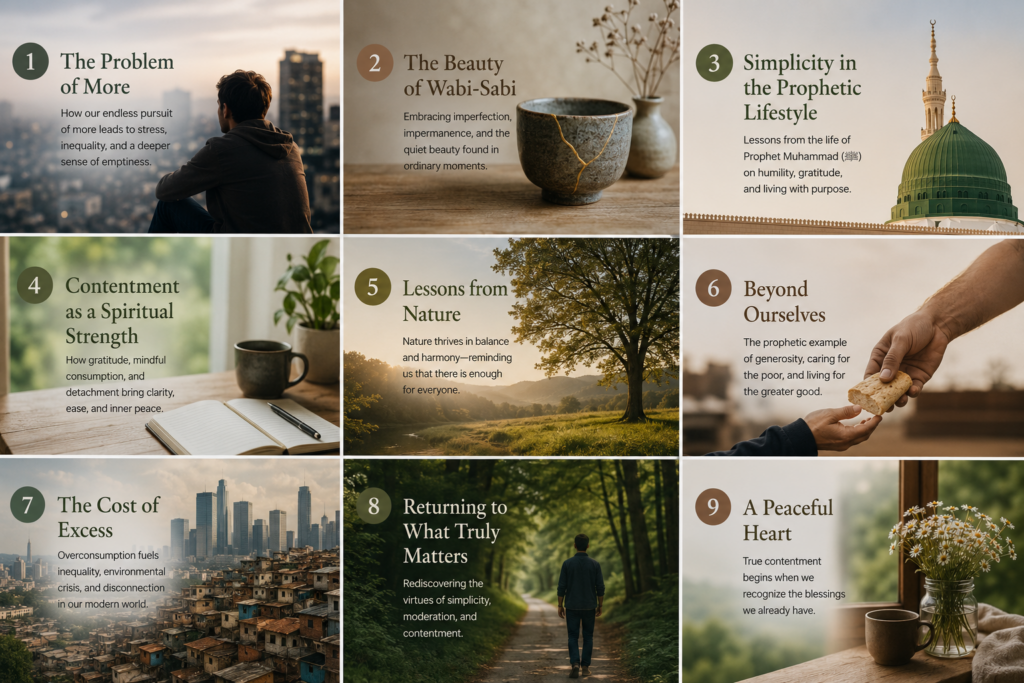
The relentless pressure of glorifying our lives through higher possessions, status, and power has put us in a never-ending cycle of unrelieved achievement and accumulation. Capitalist economy and industrialization have intentionally created this toxic loop of wastage and inadequacy through persistent comparison, planned obsolescence, and lifestyle elevation. While globalization, social media influence, and debt traps fuel this culture of endless more, it is slowly dragging humans into a myriad of ramifications. According to psychologist David G. Myers, even though today’s young adults are more affluent than their grandparents, they are less happy, with higher chances of developing depression and social disorders (DeAngelis, 2004). Researchers are increasingly finding evidence that such recurring urge of deficiency not only brings in financial strains, poor wellbeing, and environmental distress, but also curtails happiness in the search for an endless pursuit of external validation.

In response to the global climate crisis and social adversities, many people today are embracing sophisticated philosophies like Minimalism and simplicity. These have recently gained popularity over the last decade in the Western world and are also being promoted through social media, podcasts, streaming entertainment platforms like Netflix, YouTube, and TED Talks. Similarly, the Japanese principle of Wabi-Sabi teaches the notion of appreciating beauty in ordinary, quiet moments of life. As materialism inflates our artificial dispositions, this concept inspires us to seek elegance through a lens of imperfection, impermanence, and transience. For example, a cracked teacup, which holds the passage of time, or the fallen leaves in a forest, manifests history. Wabi-Sabi encourages us to appreciate anomaly without the need for replacement.
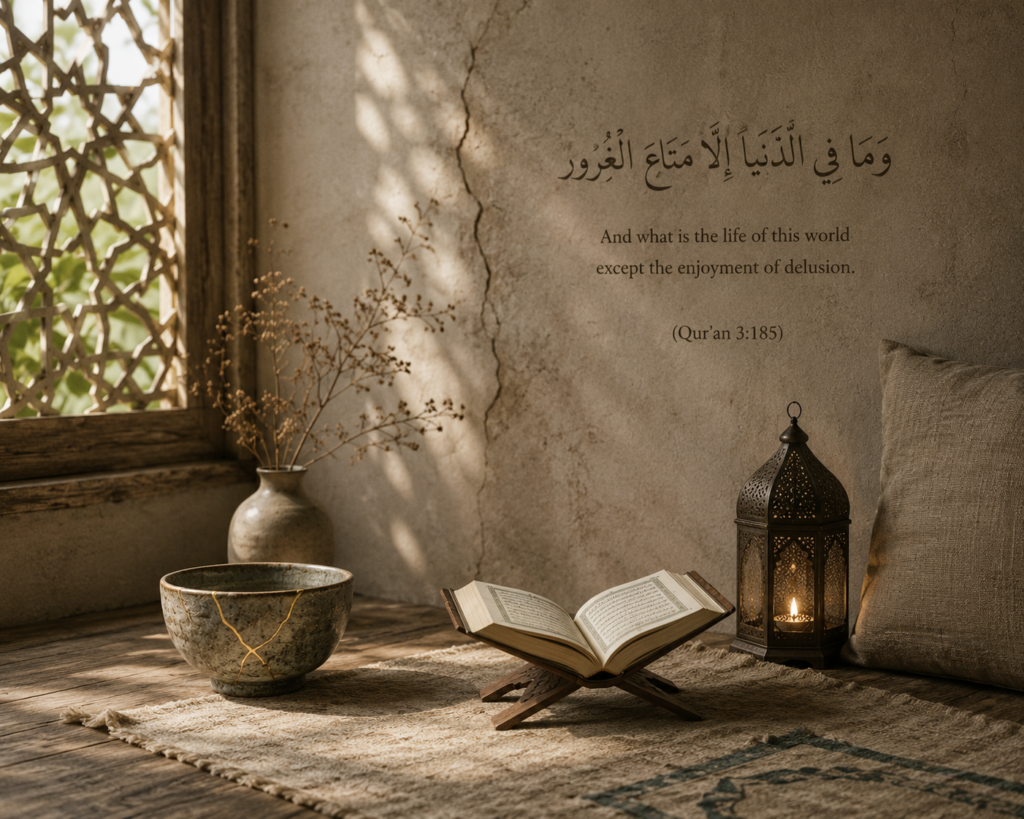
Interestingly, the same essence can be found in the prophetic lifestyle in Islam. While Wabi-sabi emerged from Japanese culture, the appreciation for simplicity and modesty was always profound in the Islamic art of living. The Prophet Muhammad (peace be upon him) led a balanced life, being grateful for every little blessing he had. He used to spend time with his companions, listen to the poor, and eat from whatever he had. His lifestyle deeply resonates with detachment from material excess and focus on inward purpose. He maintained humility even after becoming the leader of the Arab peninsula, when Islam spread rapidly across nations, and numerous people accepted this religion. One day, companion Umar ibn Khattab (RA) saw him sleeping on a coarse mat and couldn’t hold his tears. He said, “O Messenger of Allah, how can we allow you to live like this? Look at the kings of Roman, Persia. Look at how lavishly they live. Surely, O Messenger of Allah, you deserve better. The Prophet (peace be upon him) replied: O Umar, aren’t you happy that they have this ‘Dunia’ (this life) and we have the ‘Akhira’ (the afterlife)? (Sahih Bukhari 1).
Our prophet taught us beautifully about mindful consumption, benevolence, and clarity of purpose. He emphasized treating this earthly life as a journey to reach the permanent destination and, therefore, detaching the heart from material clutter. This can keep our spiritual connection clear and deeply rooted in the guidance of the Almighty Allah. Furthermore, when such distractions are removed from life, we can be more thoughtful of our expenditure and restore ease in every action. It also clears away the audacity, ego, and prejudice over others and remains humble with all creatures of Allah. The Islamic term Zuhd (detachment from tangible possessions) substantially reflects this value; living in this world without getting immersed in it and balancing spirituality to attain eternal happiness in the afterlife. The moderation in the Prophet’s life was not simply minimalism; rather, at its core lies a formidable spiritual quality: contentment with what Allah has provided. Despite his status, Prophet Muhammad (peace be upon him) often used to give away any expensive gifts as charity among the poor and less fortunate citizens of Madinah, and spent days with little food or cooked meals. Yet, he remained fulfilled for what he had, and expressed gratitude through long night prayers until his feet would crack. When Aisha (RA) asked him, “O Messenger of Allah, why are you doing this while your past and future sins have been forgiven?” He replied, “Should I not be a thankful slave?”(Sahih Al-Bukhari & Sahih Muslim2).
One of the places where this phenomenon can be clearly observed is nature itself. It flourishes over decades through cooperation, ecological harmony, and inclusion. Plants and animals sustain themselves through symbiosis, seasonal synchronization, and biodiversity. There is space for every organism to grow, which restores and enriches the ecosystem. Human beings can prosper through similar balance, yet modern living is pulling us away from this moderation, stimulating overconsumption, speed, and discrepancy. This has given rise to inequality between rich and poor, food insecurity, and hostility among nations. According to the 2022 World Inequality Report, the top 10% owns 76% of global wealth and the bottom half of the population owns 2% of it, indicating a surge in income and wealth disparity (Business Insider, 2021).
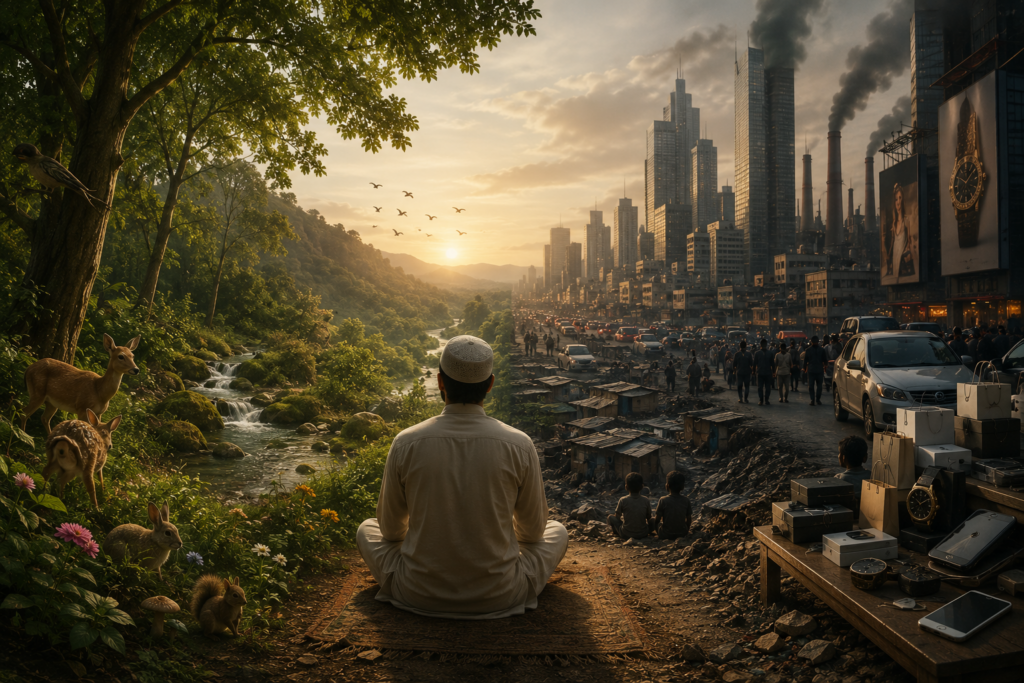
As Muslims, it’s the optimal time for us to return to the virtues left by our Messenger of Allah, Muhammad (peace be upon him). His life was a perfect example of harmony and contentment. While he recognized human desires, true satisfaction comes from abstinence and a sense of having enough. This can bring barakah and dignity in our lives. In a culture that continuously demands indulgence, arrogance, and superiority, both Islam and Wabi-Sabi endorse that inner peace is often found by rediscovering the beauty and blessing in slowing down, presence, and being grateful for what we already have. As Allah reminds us, “Verily, in the remembrance of Allah do hearts find rest” (13:28)3.
References
DeANGELIS, T. (2004). Consumerism and its discontents. American Psychological Association. https://www.apa.org/monitor/jun04/discontents
Kaplan, Juliana; Kiersz, Andy (December 7, 2021). “A huge study of 20 years of global wealth demolishes the myth of ‘trickle-down’ and shows the rich are taking most of the gains for themselves”. Business Insider
- Sahih Bukhari 4913
- Sahih Bukhari 1130 and 4836, Sahih Muslim 2819
- Surah Ar Ra’d, verse 28.