Author: Md. Hamidur Rahman (Marine Engineer, Permaculturist)
Table of Contents
- Introduction: The Missing Dimension of Permaculture
- What Is Social Permaculture?
- The Evolution of Permaculture: From Land to Human Systems
- Why Social Permaculture Matters in the Twenty-First Century
- The Ethics That Guide Social Permaculture
- Communities as Living Ecosystems
- Beyond Money: Rethinking Wealth Through the Eight Forms of Capital
- Human Polycultures: Designing Communities Through Diverse Roles
- Social Permaculture Through an Islamic Worldview
- Regeneration Begins Within
- How Social Permaculture Shapes Sukun Regenerative Culture
- Lessons from Bangladesh: Building Regenerative Communities
- From Projects to Relationships
- The Journey from Peace to Regeneration
- Conclusion: Designing a Regenerative Future
Introduction: The Missing Dimension of Permaculture
Around the world, thousands of people are restoring forests, regenerating degraded land, harvesting rainwater, and transforming urban spaces into productive gardens. These efforts demonstrate the remarkable potential of ecological permaculture to heal damaged landscapes and create resilient food systems. Yet despite this growing movement, another crisis continues to deepen—one that cannot be solved by ecological design alone.
Communities are becoming increasingly fragmented. Loneliness and social isolation are rising across many societies. Traditional knowledge is disappearing, trust between neighbours is declining, and many people feel disconnected from nature, culture, and even from a deeper sense of purpose. These challenges reveal an important truth: ecological regeneration alone cannot create a regenerative society.
Permaculture has always been about designing systems that sustain life. However, human beings do not exist only within ecological systems. We also live within families, friendships, institutions, cultures, and communities. If these human systems are unhealthy, even the most beautifully designed landscapes may struggle to endure.
This realization has led to the emergence of Social Permaculture—an approach that applies permaculture ethics and design principles to human relationships, organizations, and communities. It recognizes that lasting regeneration begins not only with the restoration of land but also with the restoration of relationships.
At Sukun Regenerative Culture, this understanding lies at the heart of our vision. We believe that regeneration is more than an environmental process. It is also social, cultural, psychological, and spiritual. Healthy landscapes grow from healthy communities, and healthy communities emerge from people who learn to care for one another, for creation, and ultimately for the Creator.
What Is Social Permaculture?
Social Permaculture is the application of permaculture thinking to human systems. Rather than focusing only on gardens, farms, or ecological landscapes, it asks how we can intentionally design healthier communities, stronger organizations, and more resilient relationships.
Just as ecological permaculture studies the patterns and relationships found in nature, Social Permaculture studies the patterns and relationships that exist within human communities. It explores questions such as: How do communities make decisions? How is leadership shared? How can conflicts become opportunities for learning? How can people work together without burnout? How do communities preserve knowledge, welcome newcomers, and adapt to change?
In essence, Social Permaculture seeks to create the social conditions that allow both people and ecosystems to flourish. It recognizes that every successful ecological project depends upon healthy relationships, shared responsibility, trust, and collaboration.
Rather than viewing communities as machines to be managed, Social Permaculture sees them as living ecosystems that require care, diversity, participation, and continual learning.
The Evolution of Permaculture: From Land to Human Systems
When Bill Mollison and David Holmgren first introduced permaculture in the 1970s, much of their work focused on designing sustainable agricultural systems inspired by natural ecosystems. Their pioneering work transformed how people thought about food production, water management, energy, and ecological restoration.
As the movement matured, practitioners around the world began to notice an important pattern. Many technically excellent ecological projects struggled—not because the design of the land was poor, but because the human relationships behind the projects were weak. Communities experienced leadership burnout, unresolved conflict, poor communication, and a lack of shared vision.
These experiences gradually expanded the scope of permaculture itself. Practitioners realized that designing landscapes was only part of the challenge. Equally important was designing the human systems responsible for caring for those landscapes.
This evolution gave rise to Social Permaculture—a natural extension of the original permaculture vision. Rather than replacing ecological permaculture, it complements it by recognizing that social and ecological regeneration are deeply interconnected. Healthy landscapes depend upon healthy communities, just as healthy communities depend upon healthy landscapes.
Why Social Permaculture Matters in the Twenty-First Century
We live in an age of remarkable technological advancement, yet many people experience increasing loneliness, anxiety, and disconnection. While digital technologies have connected us across continents, they have not always strengthened our relationships with neighbours, families, or the natural world.
At the same time, humanity faces unprecedented ecological challenges, including climate change, biodiversity loss, soil degradation, and water scarcity. These are often described as environmental crises, yet they are also crises of culture, values, and relationships.
Social Permaculture recognizes that many environmental problems originate within human systems. Patterns of excessive consumption, exploitation, inequality, and ecological destruction emerge from how societies organize themselves and how people relate to one another and to nature.
If the roots of these problems are social, then many of the solutions must also be social. Regeneration requires not only restoring forests and rivers but also rebuilding trust, cooperation, cultural wisdom, and shared responsibility.
The Ethics That Guide Social Permaculture
At the heart of Social Permaculture are the three ethics that have guided the permaculture movement since its beginning: Earth Care, People Care, and Fair Share.
Earth Care reminds us that human wellbeing is inseparable from the wellbeing of the ecosystems that sustain life. Every community ultimately depends upon healthy soil, clean water, stable climates, and thriving biodiversity.
People Care recognizes that communities flourish when individuals experience dignity, belonging, purpose, and opportunities to contribute. Healthy societies invest not only in infrastructure but also in human wellbeing.
Fair Share encourages a culture of justice, generosity, and responsibility. It reminds us that resources, opportunities, and responsibilities should be shared in ways that strengthen the resilience of both present and future generations.
These ethics are not abstract ideals. They provide practical guidance for designing organizations, neighbourhoods, educational initiatives, and communities that seek long-term flourishing.
Communities as Living Ecosystems
One of the most profound ideas within Social Permaculture is that communities function much like ecosystems.
Imagine walking through a mature forest. No single species performs every function. Trees provide shelter, fungi recycle nutrients, insects pollinate flowers, birds disperse seeds, and microorganisms sustain the soil beneath them all. Diversity creates resilience.
Human communities operate in much the same way.
Every community depends upon individuals with different gifts, experiences, and personalities. Some teach. Some organize. Some care for others. Some preserve culture and history. Others innovate, connect people, resolve conflicts, or quietly serve behind the scenes.
When responsibility becomes concentrated in only a few people, burnout often follows. When communities intentionally cultivate diversity of roles and shared responsibility, resilience grows naturally.
Social Permaculture encourages us to see every individual not simply as a participant but as an important contributor within a larger living system.
Beyond Money: Rethinking Wealth Through the Eight Forms of Capital
One of the most transformative ideas within Social Permaculture is that wealth cannot be measured by money alone.
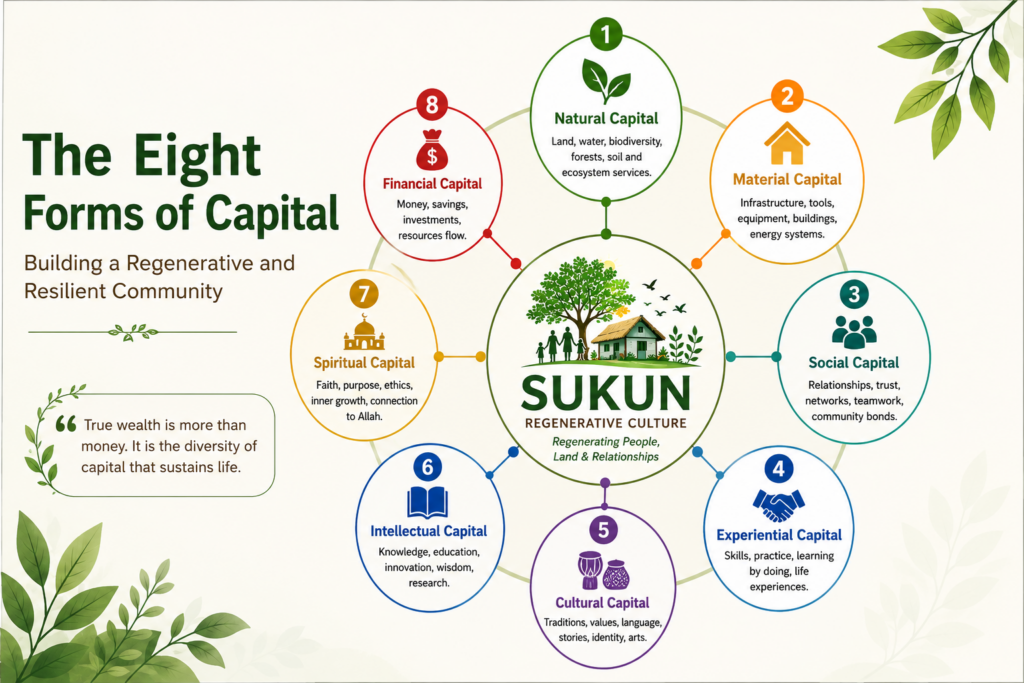
Communities possess many forms of capital that are often overlooked. A village may have little financial wealth yet possess extraordinary social trust, cultural traditions, ecological knowledge, spiritual values, and practical skills. These resources frequently determine whether a community thrives far more than financial investment alone.
Social Permaculture recognizes eight forms of capital: natural, material, social, cultural, intellectual, experiential, spiritual, and financial. Together, these forms of capital provide a richer understanding of community resilience.
For grassroots organizations, this perspective is deeply empowering. It reminds us that meaningful change does not always begin with funding. It often begins by recognizing and strengthening the resources that already exist within a community.
Human Polycultures: Designing Communities Through Diverse Roles
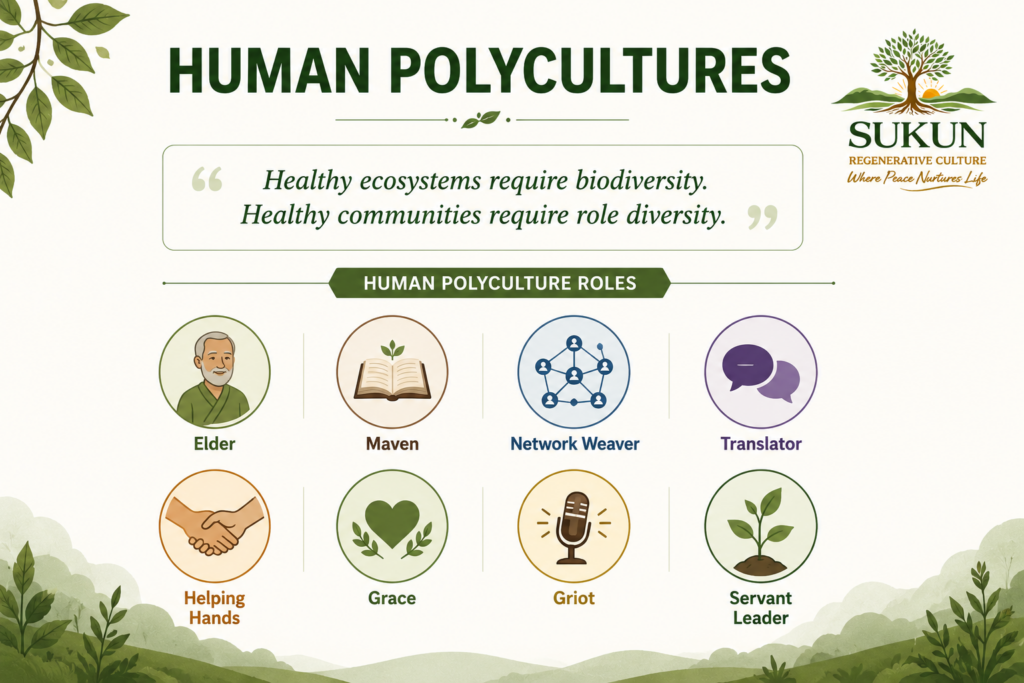
In ecological permaculture, polycultures create stability because different species support one another through complementary functions. Social Permaculture applies this same principle to human communities.
Every healthy community requires educators, organizers, elders, storytellers, network builders, caregivers, mentors, artists, volunteers, innovators, and servant leaders. Each role contributes something unique to the health of the whole.
Rather than expecting everyone to contribute in the same way, Social Permaculture celebrates diversity. It encourages people to discover their strengths and contribute according to their gifts.
Just as biodiversity strengthens ecosystems, diversity of people and roles strengthens communities.
Social Permaculture Through an Islamic Worldview
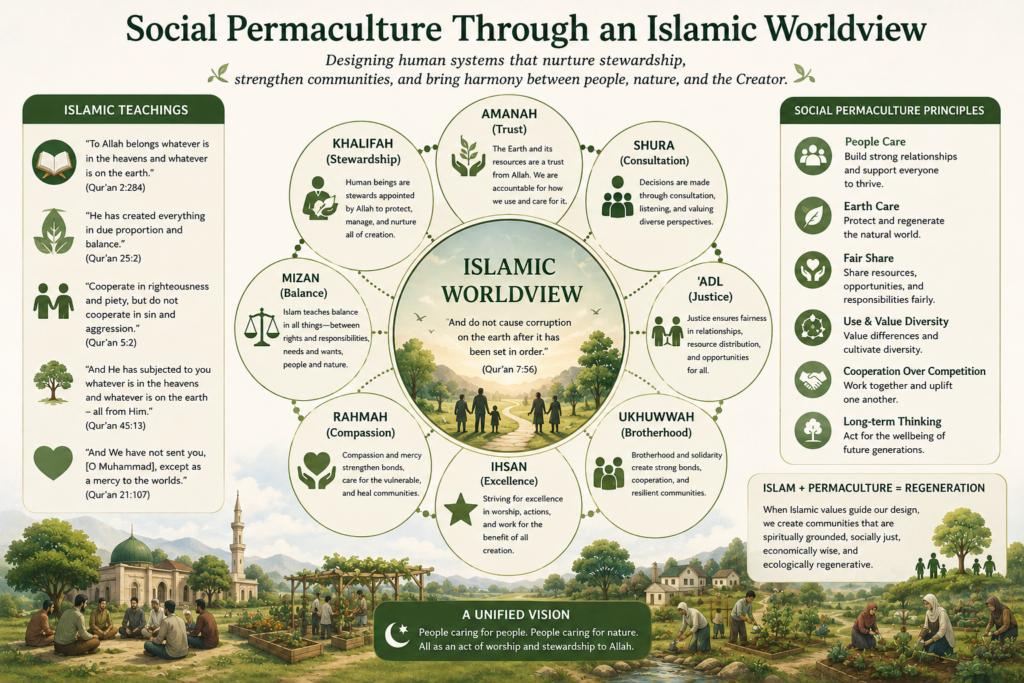
For Muslims, many principles of Social Permaculture resonate naturally with the teachings of Islam.
The Qur’an repeatedly reminds humanity that creation is a trust (Amanah) and that human beings have been appointed as stewards (Khalifah) upon the Earth. Decision-making through consultation (Shura), justice (‘Adl), excellence (Ihsan), and brotherhood (Ukhuwwah) are foundational principles for healthy communities.
Islam also emphasizes balance (Mizan), compassion (Rahmah), and the recognition that all creation glorifies Allah in its own way. These teachings encourage relationships rooted in responsibility rather than domination and cooperation rather than competition.
Social Permaculture therefore provides practical design tools that can help communities embody values already deeply embedded within the Islamic worldview. Rather than viewing ecology and spirituality as separate, both become part of a unified vision of stewardship and human flourishing.
Regeneration Begins Within
Before landscapes can be regenerated, people themselves must also experience transformation.
Communities are ultimately reflections of the individuals who compose them. A culture of compassion grows from compassionate people. A culture of trust grows from trustworthy individuals. Likewise, regenerative communities emerge from people who cultivate responsibility, humility, patience, and service.
From an Islamic perspective, this process begins with Tazkiyah al-Nafs—the purification and development of the self. Inner transformation shapes outward action. As hearts become more mindful of Allah, relationships become healthier, communities become stronger, and stewardship of creation becomes more sincere.
Social Permaculture reminds us that designing better systems is important, but nurturing better people is equally essential.
How Social Permaculture Shapes Sukun Regenerative Culture
At Sukun Regenerative Culture, Social Permaculture serves as one of the guiding frameworks for community development. Our work extends beyond ecological restoration to include education, community building, spiritual development, and cultural renewal.
We seek to cultivate communities where learning, stewardship, belonging, and service are woven together. Rather than focusing only on projects, we invest in relationships. Rather than measuring success solely through infrastructure, we also value trust, collaboration, participation, and shared purpose.
Whether through regenerative education, therapeutic gardens, community gatherings, outdoor learning, or ecological restoration, our goal is to cultivate a culture in which people, nature, and faith grow together.
For us, regeneration is not merely about producing food or planting trees. It is about restoring the living relationships that sustain both communities and landscapes.
Lessons from Bangladesh: Building Regenerative Communities
Bangladesh possesses remarkable strengths that are often overlooked. Despite economic challenges, many communities continue to preserve traditions of hospitality, cooperation, faith, and mutual support. Rural villages still hold deep reservoirs of social, cultural, and spiritual capital.
At the same time, rapid urbanization, climate change, migration, and changing lifestyles present significant challenges for community life.
Social Permaculture offers a framework that builds upon existing strengths rather than replacing them. It encourages communities to preserve traditional wisdom while embracing thoughtful innovation. It recognizes that sustainable development is not simply about economic growth but about strengthening relationships between people, culture, and the environment.
For Bangladesh, this approach holds great potential for creating resilient communities capable of facing both social and ecological challenges.
From Projects to Relationships
Perhaps the greatest lesson of Social Permaculture is that relationships themselves are a form of capital.
Projects may succeed or fail. Funding may increase or decrease. Buildings may eventually deteriorate.
Relationships, however, continue generating trust, learning, creativity, and resilience long after individual projects have ended.
This realization changes the questions we ask.
Instead of asking, “What should we build?”, we begin asking, “What relationships need to be nurtured?”
This simple shift transforms organizations into communities and projects into movements.
The Journey from Peace to Regeneration
For Sukun Regenerative Culture, regeneration is ultimately a journey.
It begins with peace—peace within ourselves, peace with our Creator, peace with one another, and peace with the natural world.
From that foundation emerges regeneration: the renewal of ecosystems, the strengthening of communities, the revival of culture, and the cultivation of hope.
This journey is not completed through one project or one generation. It is an ongoing commitment to designing systems that nurture life in all its dimensions.
It is, quite simply, a journey from peace to regeneration.
Conclusion: Designing a Regenerative Future
The future will not be shaped by technology alone, nor by environmental restoration alone. It will be shaped by the quality of our relationships—with ourselves, with one another, with nature, and with the Creator.
Social Permaculture reminds us that healthy ecosystems and healthy communities are inseparable. When we intentionally design social systems rooted in trust, participation, stewardship, and shared responsibility, we create the conditions in which both people and nature can flourish.
At Sukun Regenerative Culture, we believe that regeneration is more than an environmental objective; it is a way of life. It is the restoration of the bonds between soul, soil, and society. It is the cultivation of communities where knowledge is shared, compassion is practiced, creation is cared for, and faith inspires responsible stewardship.
As our world faces growing ecological and social challenges, Social Permaculture offers more than a set of design tools. It offers a hopeful vision of communities that are resilient, compassionate, and deeply connected. It invites us to move beyond simply creating sustainable projects toward cultivating a truly regenerative culture.
The journey begins with a single question: How can we design our lives, our relationships, and our communities so that future generations inherit a world that is healthier, wiser, and more compassionate than the one we received?
At Sukun, this is the question that guides our work—and the invitation we extend to everyone seeking to journey from peace to regeneration.