In a time of spiritual decline, ecological crisis, and social instability, the Qur’an offers timeless guidance. Among the most powerful Surahs for navigating such trials is Surah Al-Kahf, which the Prophet ﷺ recommended reciting every Friday as protection from the greatest fitan.
Surah Al-Kahf presents four defining trials of human existence:
Faith
Wealth
Knowledge
Power
These are not distant narratives—they are the realities shaping our world today.
Why Now?
Today’s systems are failing—spiritually, socially, and environmentally. People are more connected than ever, yet more isolated. Wealth is increasing, yet inequality is growing. Technology advances, yet purpose is fading.
The question is no longer whether change is needed— But what kind of life are we moving toward?
An ecovillage—a spiritually grounded, environmentally sustainable, intentional community—emerges as a response to these trials. It is a way of living rooted in the Qur’an and Sunnah, preparing individuals and communities for the challenges of our time.
What is an Ecovillage in Practice?
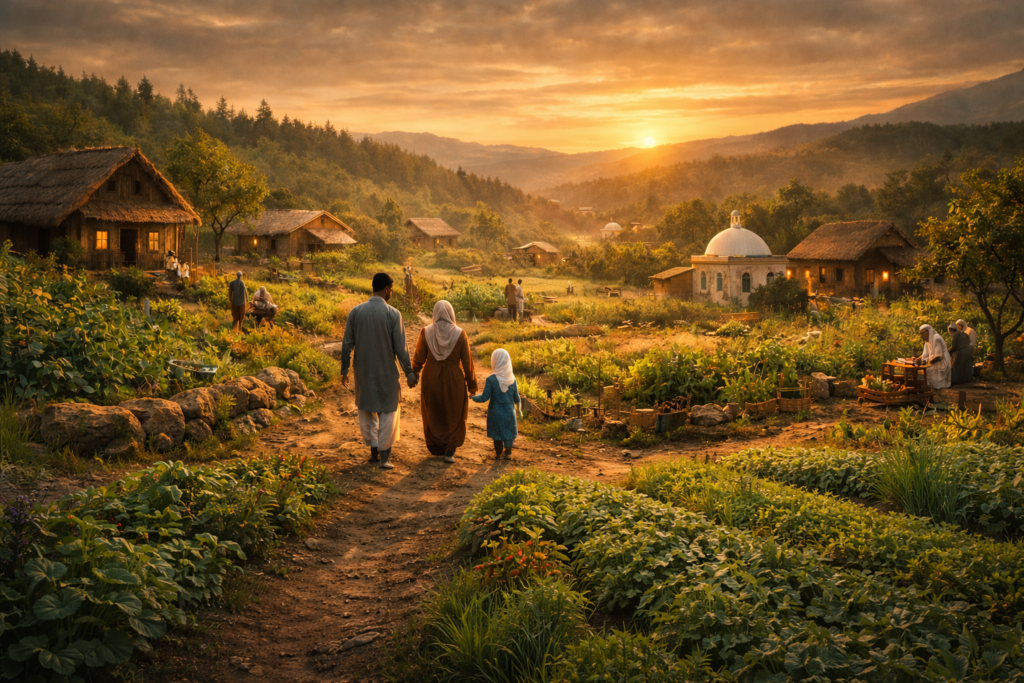
An ecovillage is not just an idea—it is a way of life:
Families living in a close, value-based community
Food grown locally and sustainably
Daily life centered around worship and purpose
Shared responsibility instead of isolated living
It is a shift from consumption to contribution, from isolation to community, from distraction to meaning.
The Four Foundations
1. Faith: Retreat and Revival
Surah Reference: 18:9–26
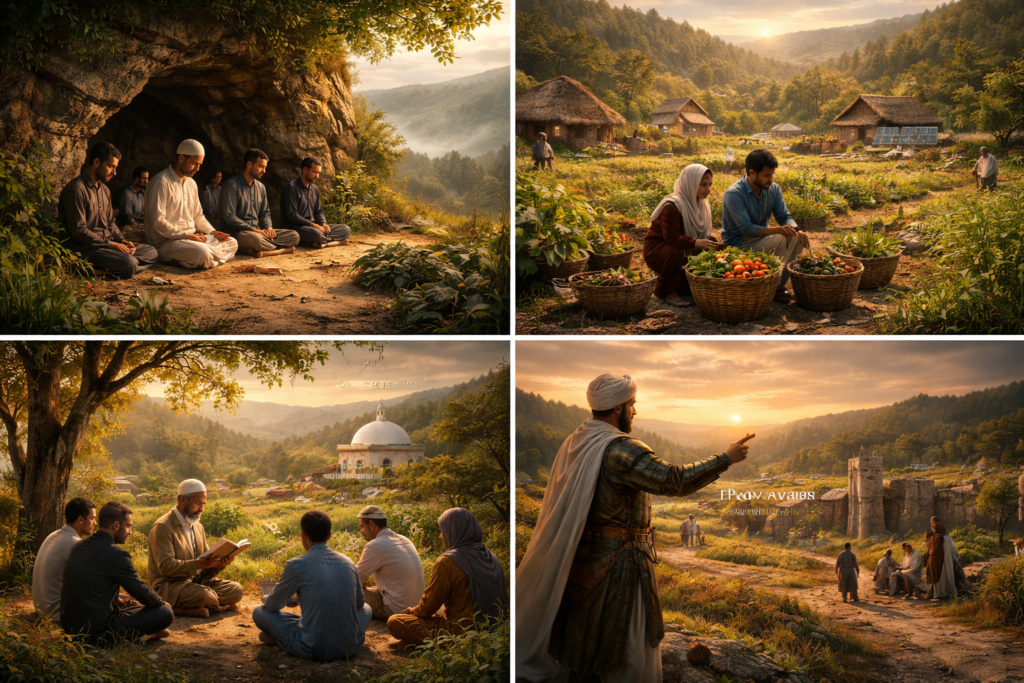
A group of young believers withdrew from a corrupt society to preserve their faith, trusting Allah completely.
إِنَّهُمْ فِتْيَةٌ آمَنُوا بِرَبِّهِمْ وَزِدْنَاهُمْ هُدًى “Indeed, they were youths who believed in their Lord, and We increased them in guidance.” (18:13)
Ecovillage Reflection: An ecovillage reflects this withdrawal—not as escape, but as preservation and renewal. It creates an environment where Iman is protected, worship is central, and Islamic values are lived collectively.
Like the cave, it becomes a space for Hijrah of the heart and life—away from distraction, toward clarity and purpose.
2. Wealth: Simplicity and Sustainability
Surah Reference: 18:32–44
The story of the two gardens reveals the danger of arrogance and attachment to wealth.
أَكَفَرْتَ بِالَّذِي خَلَقَكَ “Do you disbelieve in the One who created you…?” (18:37)
Ecovillage Reflection: An ecovillage challenges the modern obsession with accumulation and excess. It replaces it with simplicity, sustainability, and gratitude.
Through local food systems, shared resources, and mindful living, it reflects a Qur’anic relationship with wealth—recognizing that provision comes from Allah, and that true success lies in balance, not abundance.
3. Knowledge: Humility and Wisdom
Surah Reference: 18:60–82
The journey of Musa and Khidr reveals that true knowledge goes beyond what is seen.
وَكَيْفَ تَصْبِرُ عَلَىٰ مَا لَمْ تُحِطْ بِهِ خُبْرًا “And how can you have patience for what you do not encompass in knowledge?” (18:68)
Ecovillage Reflection: In an ecovillage, knowledge is not just information—it is transformation. It combines revelation with lived experience, producing individuals grounded in both understanding and humility.
It nurtures people who seek hikmah, act with awareness, and trust in Allah’s wisdom beyond what they can immediately comprehend.
4. Power: Justice and Responsibility
Surah Reference: 18:83–98
Dhul-Qarnayn exemplifies power used with justice and purpose.
فَأَعِينُونِي بِقُوَّةٍ أَجْعَلْ بَيْنَكُمْ وَبَيْنَهُمْ رَدْمًا “So help me with strength; I will build between you and them a barrier.” (18:95)
Ecovillage Reflection: An ecovillage builds strength through unity, structure, and responsibility. Leadership is rooted in consultation and accountability, not control.
It develops resilience—through self-reliance, cooperation, and strong social bonds—creating communities capable of standing firm in times of uncertainty.
The challenges facing Muslims are not isolated—they are part of a wider human crisis.
Across the world, people are experiencing:
Disconnection from nature
Breakdown of family and community
Rising mental and emotional instability
Dependence on fragile global systems
Loss of meaning and direction
These are not just religious problems—they are human problems.
An ecovillage responds at the root.
It restores what modern systems have fragmented:
Connection — through real, living communities
Sustainability — through balance with the natural world
Resilience — through local self-reliance
Purpose — through meaningful, value-driven living
This model works beyond Muslims because it is built on universal principles:
Justice instead of exploitation
Balance instead of excess
Community instead of isolation
Responsibility instead of consumption
While its foundation is rooted in divine guidance, its benefits extend to all.
What Islam offers as guidance, the world is now searching for as a solution.
Why the World Needs It Now
Modern civilization is advancing rapidly—but not necessarily in the right direction.
We are witnessing:
Environmental systems under strain
Social systems weakening
Economic inequality expanding
Technology is replacing human connection
These trends are not sustainable.
The question is no longer whether change will come— But whether it will be intentional or forced.
Ecovillages represent an intentional shift:
From centralization to local resilience
From consumption to stewardship
From isolation to belonging
They are not a rejection of progress— But a correction of direction.
Conclusion: A Living Response
Surah Al-Kahf is more than protection—it is a blueprint for living through trials.
An ecovillage embodies this guidance by:
Preserving faith
Practicing humility in wealth
Seeking knowledge with wisdom
Exercising power with justice
It becomes a living reflection of Qur’anic principles.
For Muslims, it is a path to live Islam more completely. For humanity, it offers a model of balance, sustainability, and meaningful community in a time of crisis.
Moving Forward
An ecovillage is not withdrawal from the world—it is the rebuilding of it on stronger foundations.
A return to balance. A return to purpose. A return to Allah.
Final Thought
The question is not whether this way of life is possible— The question is whether we are ready to build it.
Hadith “Whoever recites Surah Al-Kahf on Friday…” — Sahih al-Jami‘
Islamic Scholarship Ibn Kathir — Tafsir al-Qur’an al-‘Azim Sayyid Qutb — Fi Zilal al-Qur’an Imran N. Hosein — Surah Al-Kahf and the Modern Age Abul Hasan Ali Nadwi — Faith Versus Materialism: The Message of Surat al-Kahf Maulana Manazir Ahsan Gilani — Tazkeer Ba-Suratul-Kahaf Ibn Abi al-Dunya — The Book of Seclusion (original Arabic: Kitab al-Uzlah)
Ecovillage & Sustainability Global Ecovillage Network — ecovillage.org Jonathan Dawson — Ecovillages Karen Litfin — Ecovillages
Md. Hamidur Rahman is a marine engineer, systems thinker, and certified permaculture designer and teacher. He is the Founder of Mindful Meadows and works at the intersection of ecological design, psychology, and regenerative systems from an Islamic perspective.