
Author: Md. Hamidur Rahman
Table of contents:
- The Modern Mental Health Crisis
- The Growing Disconnect from Nature
- What Science Tells Us About Nature and Well-Being
- Why Nature Heals
- The Rise of Ecotherapy
- Beyond Psychology: Nature as a Source of Meaning
- Nature in the Islamic Worldview
- Fitrah and the Human Need for Nature
- When We Become Disconnected
- Toward an Islamic Ecopsychology
- Healing Through Stewardship
- Conclusion: Returning to Fitrah
The Modern Mental Health Crisis

Across the world, mental health challenges are increasing at an alarming rate. Anxiety, depression, loneliness, burnout, chronic stress, and emotional exhaustion have become defining features of contemporary life. Despite remarkable advances in medicine, technology, and psychological science, many individuals continue to struggle with a persistent sense of disconnection, dissatisfaction, and loss of meaning.
The World Health Organization estimates that hundreds of millions of people experience mental health disorders each year. While biological, social, and economic factors undoubtedly contribute to psychological distress, researchers are increasingly exploring whether modern lifestyles themselves may be contributing to the problem.
Many contemporary approaches to mental health focus on symptoms, diagnoses, and treatment techniques. While these approaches have significant value, they may overlook deeper questions about how human beings are meant to live and what conditions support genuine flourishing. Increasingly, psychologists, ecologists, and philosophers are asking whether the erosion of our relationship with the natural world may be one of the hidden factors contributing to the mental health crisis of our time.
The Growing Disconnect from Nature
For most of human history, people lived in close relationship to nature. Daily life involved direct engagement with the land, seasons, plants, animals, and natural cycles. Human communities depended upon local ecosystems not only for survival but also for identity, culture, and meaning.
Today, this relationship has changed dramatically.
Urbanization has concentrated large populations into highly built environments. Digital technologies occupy increasing portions of daily life. Many people spend most of their waking hours indoors, interacting with screens rather than landscapes. Consumer culture often encourages acquisition and consumption rather than connection and stewardship.
Richard Louv famously described this phenomenon as “nature-deficit disorder,” referring not to a clinical diagnosis but to the growing absence of nature from everyday life. Children and adults alike may spend less time outdoors than any previous generation.
This separation from nature has consequences beyond physical health. Ecopsychologists argue that modern societies often produce a form of ecological alienation—a condition in which people become disconnected from the living systems that sustain them. As natural relationships weaken, many individuals experience increasing feelings of isolation, rootlessness, and disconnection from place.
The ecological crisis and the mental health crisis may therefore be more closely related than we often assume.
What Science Tells Us About Nature and Well-Being
Over the past several decades, Environmental Psychology has developed a substantial body of evidence demonstrating the positive effects of nature on mental health.
Research consistently shows that exposure to natural environments is associated with:
- Reduced stress and anxiety
- Improved mood
- Enhanced attention and concentration
- Greater emotional resilience
- Increased life satisfaction
- Better social relationships
- Improved psychological well-being
Bratman and colleagues (2019) reviewed a large body of evidence demonstrating that contact with nature contributes positively to mental health across diverse populations and settings.
Similarly, Hartig et al. (2014) concluded that nature exposure supports both psychological and physical health through multiple pathways, including stress reduction, cognitive restoration, social cohesion, and opportunities for physical activity.
These findings suggest that nature is not merely a pleasant backdrop for human life. Rather, healthy interaction with natural environments appears to be an important component of human well-being itself.
Why Nature Heals
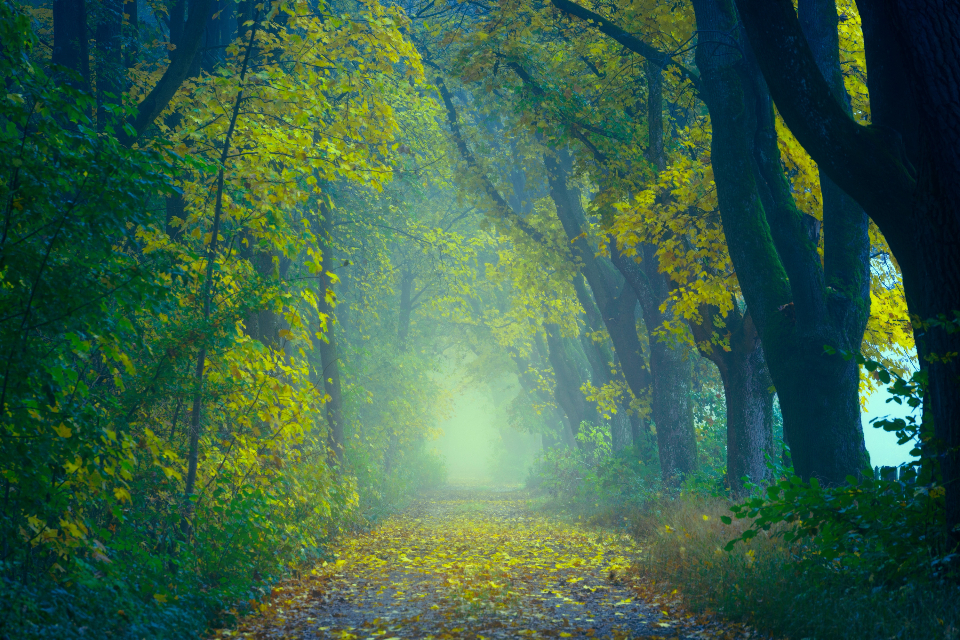
Researchers have proposed several theories to explain why natural environments produce such positive effects.
Attention Restoration Theory
Developed by Rachel and Stephen Kaplan, Attention Restoration Theory proposes that modern environments place heavy demands on directed attention. Traffic, deadlines, notifications, advertising, and constant information processing gradually exhaust our cognitive resources.
Natural environments engage attention differently. They invite what the Kaplans call “soft fascination”—a form of effortless attention that allows the mind to recover from fatigue.
Walking through a forest, watching waves on a shoreline, or observing birds in a garden can restore mental clarity and improve concentration. Studies have shown that time spent in nature can improve memory, attention, creativity, and problem-solving abilities.
Stress Reduction Theory
Roger Ulrich’s Stress Reduction Theory suggests that humans possess an innate tendency to respond positively to natural environments because our species evolved within them.
Exposure to natural settings has been associated with:
- Lower cortisol levels
- Reduced blood pressure
- Improved mood
- Faster stress recovery
- Reduced anxiety
Even brief encounters with green spaces can produce measurable physiological benefits.
The Biophilia Hypothesis
Edward O. Wilson’s Biophilia Hypothesis proposes that human beings possess an innate affinity for life and living systems.
According to this theory, our attraction to plants, animals, landscapes, and natural processes is not accidental. It reflects a deep biological connection shaped through evolutionary history.
If this is true, then disconnection from nature may not simply remove a source of enjoyment—it may deprive us of something fundamentally necessary for psychological well-being.
The Rise of Ecotherapy
As evidence for nature’s benefits has accumulated, practitioners have increasingly incorporated nature into therapeutic practice.
Ecotherapy encompasses a wide range of approaches, including:
- Therapeutic gardening
- Forest bathing
- Nature immersion
- Wilderness therapy
- Ecological restoration
- Outdoor counselling
- Animal-assisted interventions
These approaches recognize that healing often occurs not only through conversation but through relationship—relationship with place, community, living systems, and meaningful activity.
Gardening, for example, has been associated with reduced depression, improved mood, increased self-esteem, and stronger social connections. Ecological restoration projects can foster a sense of purpose and contribution. Nature-based group activities often strengthen belonging and community cohesion.
Ecotherapy shifts the focus from treating individuals in isolation to understanding human beings as participants within larger ecological systems.
Beyond Psychology: Nature as a Source of Meaning
Nature’s value extends beyond measurable psychological outcomes.
Many people describe profound experiences of awe, wonder, beauty, gratitude, and connection when spending time in natural environments. Such experiences often evoke questions about meaning, purpose, and belonging.
Standing beneath ancient trees, observing a star-filled sky, or witnessing the complexity of an ecosystem can remind us that we are part of something larger than ourselves.
Researchers increasingly recognize that experiences of awe may contribute to psychological well-being by expanding perspective, reducing self-focused rumination, and fostering social connection.
Nature does not simply help us feel better. It may also help us understand ourselves differently.
Nature in the Islamic Worldview
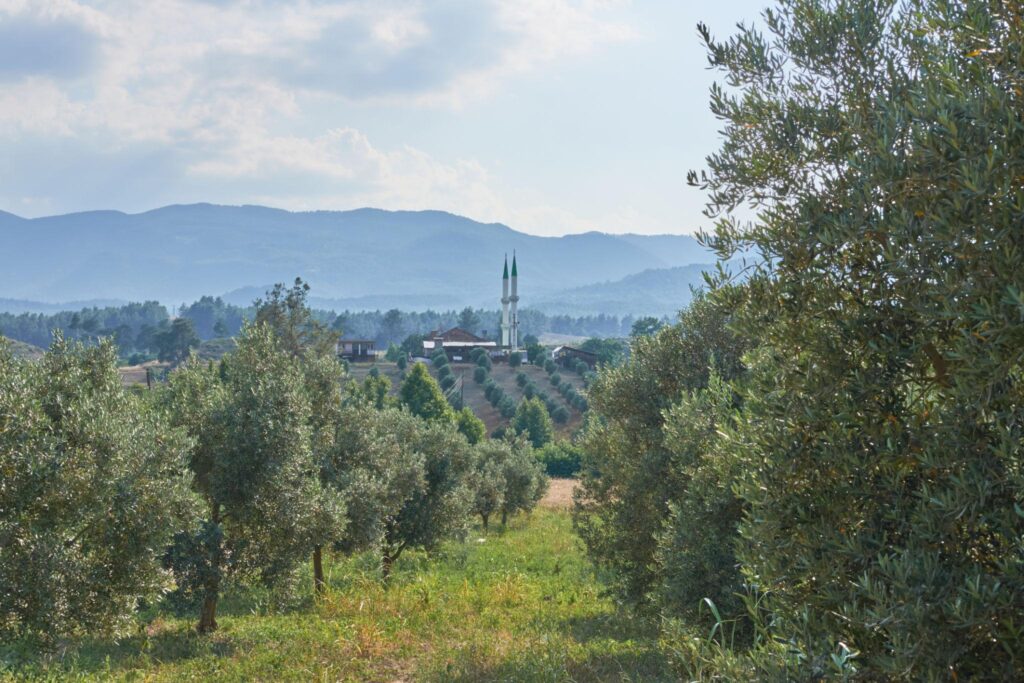
Islam offers a particularly rich framework for understanding humanity’s relationship with nature.
The Qur’an repeatedly invites reflection upon creation. Mountains, rivers, animals, plants, rain, stars, and changing seasons are presented as signs (ayat) that reveal divine wisdom and mercy.
Nature is not viewed merely as a collection of resources. It is a living manifestation of Allah’s creative power.
Creation as Signs (Ayat)
The Qur’an encourages believers to contemplate the natural world as a means of developing faith, gratitude, and wisdom. Creation points beyond itself toward the Creator.
Reflection (Tafakkur)
Contemplation of nature has long been regarded as an important spiritual practice within Islamic tradition. Reflection upon creation cultivates humility, awareness, and remembrance of Allah.
Stewardship (Khalifah)
Human beings are entrusted with the responsibility of stewardship. Rather than dominating creation, they are called to care for it responsibly and justly.
Balance (Mizan)
The Qur’an describes creation as established in balance. Human flourishing depends upon respecting and maintaining this balance rather than disrupting it through excess and exploitation.
Fitrah and the Human Need for Nature
Perhaps the most significant contribution Islamic psychology offers to discussions about nature and well-being is the concept of fitrah.
Fitrah refers to the innate disposition with which human beings are created. It includes a natural inclination toward truth, beauty, goodness, balance, and recognition of the Divine.
From this perspective, human beings are not separate from creation but emerge within it as part of a divinely ordered reality.
Environmental Psychology suggests that humans need nature because of evolutionary and psychological factors.
Islamic psychology adds another dimension: humans may need nature because connection with creation is part of their fitrah.
Nature becomes a bridge between the human being and deeper spiritual realities.
When We Become Disconnected
Modern life can disrupt several important relationships simultaneously.
We may become disconnected from nature through urbanization and indoor living.
We may become disconnected from ourselves through distraction and overstimulation.
We may become disconnected from others through social fragmentation and isolation.
We may become disconnected from Allah through forgetfulness and excessive attachment to material concerns.
These forms of disconnection often reinforce one another.
Ecological disconnection can contribute to psychological distress. Psychological distress can weaken social relationships. Social fragmentation can deepen spiritual alienation.
Understanding these relationships requires a more integrated model of human well-being.
Toward an Islamic Ecopsychology
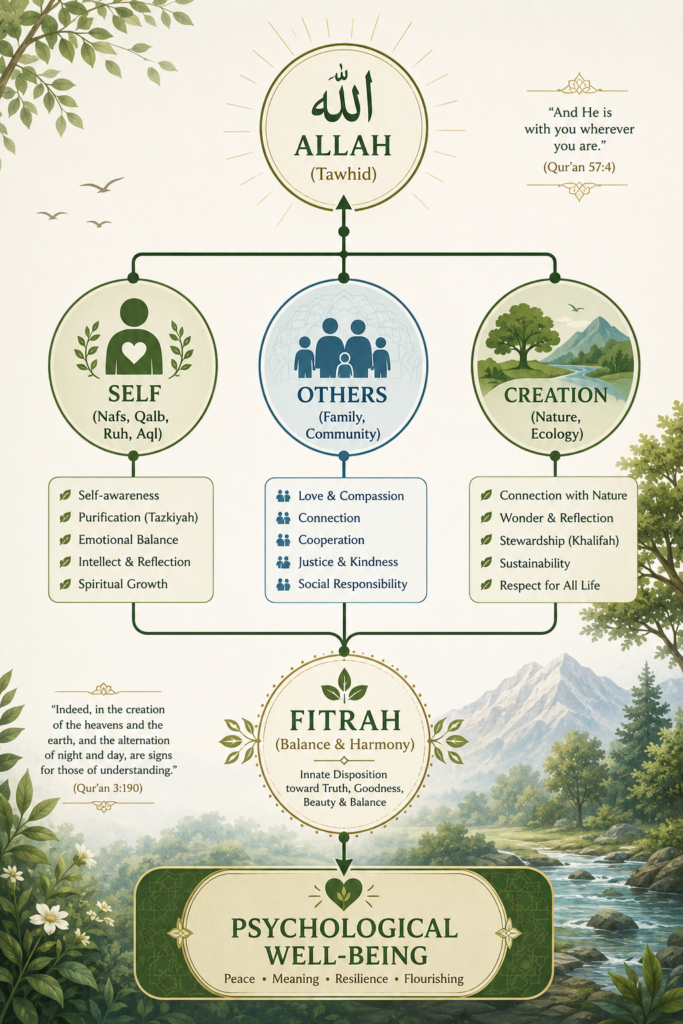
An emerging Islamic Ecopsychology seeks to integrate insights from Environmental Psychology, Ecotherapy, Ecopsychology, and Islamic Psychology.
At its core is the recognition that human well-being depends upon the quality of four fundamental relationships:
Relationship with Allah
Spiritual well-being develops through remembrance, worship, gratitude, trust, and awareness of divine presence.
Relationship with Self
Psychological health requires self-awareness, emotional regulation, personal growth, and alignment with fitrah.
Relationship with Others
Human beings flourish through healthy families, communities, cooperation, compassion, and mutual support.
Relationship with Creation
Connection with nature fosters stewardship, wonder, humility, belonging, and ecological responsibility.
Islamic Ecopsychology proposes that healing involves restoring harmony across all four relationships rather than focusing on any single dimension in isolation.
Healing Through Stewardship
One of the most promising applications of this framework lies in therapeutic gardens, regenerative landscapes, community agriculture, and permaculture.
When individuals participate in growing food, planting trees, restoring ecosystems, or caring for landscapes, they engage in activities that simultaneously support psychological, social, ecological, and spiritual well-being.
A garden can become a place of reflection.
A food forest can become a learning environment.
A community farm can become a source of belonging.
Stewardship can become an expression of gratitude and service.
In this sense, ecological restoration and personal healing may become interconnected processes.
Healing the land can contribute to healing communities.
And healing communities can contribute to healing individuals.
Conclusion: Returning to Fitra

Modern societies face intertwined crises of mental health, social fragmentation, and ecological degradation. While these challenges are complex, growing evidence suggests that reconnecting with nature may form an important part of the solution.
Environmental Psychology, Ecotherapy, and Ecopsychology demonstrate that nature supports emotional well-being, cognitive restoration, and resilience. Islamic psychology deepens this understanding by situating human well-being within a broader framework of fitrah, stewardship, balance, and spiritual development.
Perhaps the path forward is not simply to treat symptoms or manage crises. Perhaps it is also to restore relationships—relationships with Allah, with ourselves, with one another, and with the living world around us.
In returning to nature, we may rediscover forgotten dimensions of what it means to be human.
And in returning to fitrah, we may find pathways toward healing, wholeness, and regeneration.
References
Al-Ghazali. (2004). Ihya’ Ulum al-Din (Revival of the Religious Sciences). Dar al-Ma’arifa.
Awaad, R., & Ali, S. (2015). Obsessional disorders in Al-Balkhi’s 9th-century treatise: Sustenance of the soul. Journal of Affective Disorders, 180, 185–189. https://doi.org/10.1016/j.jad.2015.03.003
Bratman, G. N., Anderson, C. B., Berman, M. G., Cochran, B., de Vries, S., Flanders, J., Folke, C., Frumkin, H., Gross, J. J., Hartig, T., Kahn, P. H., Kuo, M., Lawler, J. J., Levin, P. S., Lindahl, T., Meyer-Lindenberg, A., Mitchell, R., Ouyang, Z., Roe, J., Scarlett, L., Smith, J. R., van den Bosch, M., Wheeler, B. W., White, M. P., Zheng, H., & Daily, G. C. (2019). Nature and mental health: An ecosystem service perspective. Science Advances, 5(7), eaax0903. https://doi.org/10.1126/sciadv.aax0903
Hartig, T., Mitchell, R., de Vries, S., & Frumkin, H. (2014). Nature and health. Annual Review of Public Health, 35, 207–228. https://doi.org/10.1146/annurev-publhealth-032013-182443
Jordan, M., & Hinds, J. (Eds.). (2016). Ecotherapy: Theory, Research and Practice. Palgrave Macmillan. https://doi.org/10.1057/9781137533507
Kaplan, R., & Kaplan, S. (1989). The Experience of Nature: A Psychological Perspective. Cambridge University Press.
Krasny, M. E., & Tidball, K. G. (2012). Civic ecology: A pathway for Earth stewardship in cities. Frontiers in Ecology and the Environment, 10(5), 267–273. https://doi.org/10.1890/110230
Louv, R. (2008). Last Child in the Woods: Saving Our Children from Nature-Deficit Disorder. Algonquin Books.
Mayer, F. S., & Frantz, C. M. (2004). The connectedness to nature scale: A measure of individuals’ feeling in community with nature. Journal of Environmental Psychology, 24(4), 503–515. https://doi.org/10.1016/j.jenvp.2004.10.001
Nisbet, E. K., Zelenski, J. M., & Murphy, S. A. (2009). The nature-relatedness scale: Linking individuals’ connection with nature to environmental concern and behavior. Environment and Behavior, 41(5), 715–740. https://doi.org/10.1177/0013916508318748
Pretty, J., Peacock, J., Sellens, M., & Griffin, M. (2005). The mental and physical health outcomes of green exercise. International Journal of Environmental Health Research, 15(5), 319–337. https://doi.org/10.1080/09603120500155963
Roszak, T. (1992). The Voice of the Earth: An Exploration of Ecopsychology. Simon & Schuster.
Roszak, T., Gomes, M. E., & Kanner, A. D. (Eds.). (1995). Ecopsychology: Restoring the Earth, Healing the Mind. Sierra Club Books.
Rothman, A., & Coyle, A. (2018). Toward a framework for Islamic psychology and psychotherapy: An Islamic model of the soul. Journal of Religion and Health, 57(5), 1731–1744. https://doi.org/10.1007/s10943-018-0651-x
Ulrich, R. S. (1983). Aesthetic and affective response to natural environments. In I. Altman & J. F. Wohlwill (Eds.), Behavior and the Natural Environment (pp. 85–125). Springer. https://doi.org/10.1007/978-1-4613-3539-9_4
Wilson, E. O. (1984). Biophilia. Harvard University Press.