
Author: Md. Hamidur Rahman (Marine Engineer, Permaculturist)
Introduction
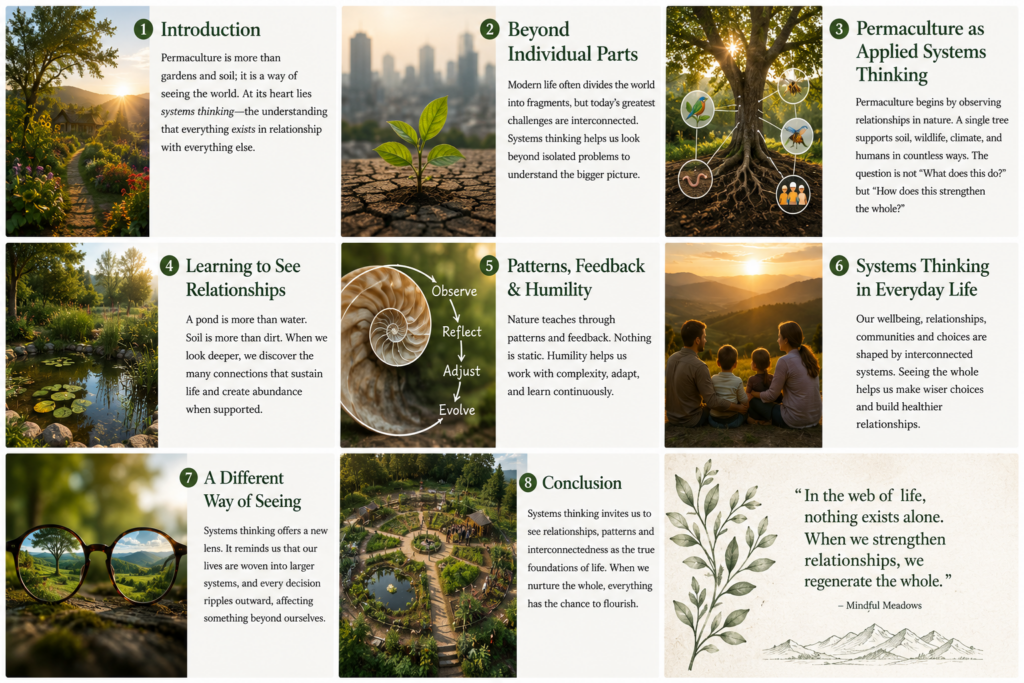
When most people first hear the word permaculture, they often imagine vegetable gardens, compost piles, fruit trees, or sustainable farming. While these are certainly part of permaculture, they are not its essence. At its heart, permaculture is a way of seeing the world. It is built upon a simple but transformative idea: everything exists in relationship with everything else.
This way of seeing is known as systems thinking. Rather than viewing life as a collection of separate parts, systems thinking invites us to understand how relationships create patterns, how patterns shape outcomes, and how every action influences the wider whole. It teaches us that lasting solutions rarely come from fixing isolated problems; instead, they emerge from strengthening the relationships that hold a system together.
Although systems thinking is one of the core foundations of permaculture, its relevance extends far beyond ecological design. It changes how we understand health, education, leadership, communities, families, and even ourselves. Once we begin to see the world through relationships rather than isolated objects, our perspective shifts in profound ways.
Beyond Individual Parts
Modern society often encourages us to think in fragments. Education separates subjects into independent disciplines. Healthcare frequently divides the body into specialised systems. Organisations divide work into departments, while people often separate their professional, personal, and spiritual lives.
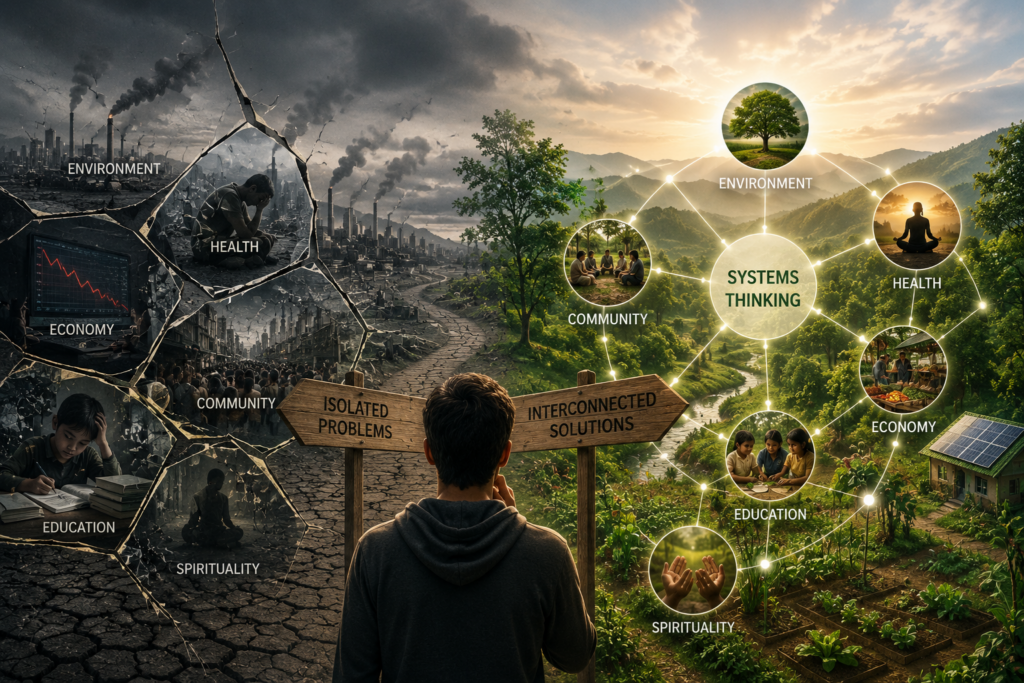
This reductionist approach has contributed greatly to scientific progress, allowing humanity to explore incredible levels of detail. Yet many of today’s greatest challenges refuse to fit neatly into these isolated categories. Climate change, declining mental health, social isolation, environmental degradation, and community fragmentation are not problems with a single cause. They are the outcomes of countless interacting relationships that have gradually become unbalanced.
Systems thinking recognises that the behaviour of any system emerges from the interactions between its parts rather than from the parts themselves. Changing one element inevitably affects many others, often in ways we do not immediately anticipate. This perspective encourages us to look beneath visible events and ask how the entire system is producing the results we observe.
Permaculture as Applied Systems Thinking
Permaculture offers one of the most practical expressions of systems thinking. Rather than beginning with individual plants or technologies, it begins by observing relationships. Every landscape contains flows of sunlight, water, nutrients, wind, wildlife, soil organisms, and human activity. Understanding these relationships allows us to design systems that work with natural processes instead of constantly struggling against them.
A simple fruit tree demonstrates this beautifully. It is not merely a source of fruit. It provides shade that cools the surrounding environment, stores carbon, improves soil through falling leaves, shelters birds and insects, supports pollinators, produces food for people and wildlife, slows the wind, moderates temperature, and contributes to the beauty and wellbeing of the landscape. None of these functions exists independently. Each supports countless others, creating resilience throughout the ecosystem.
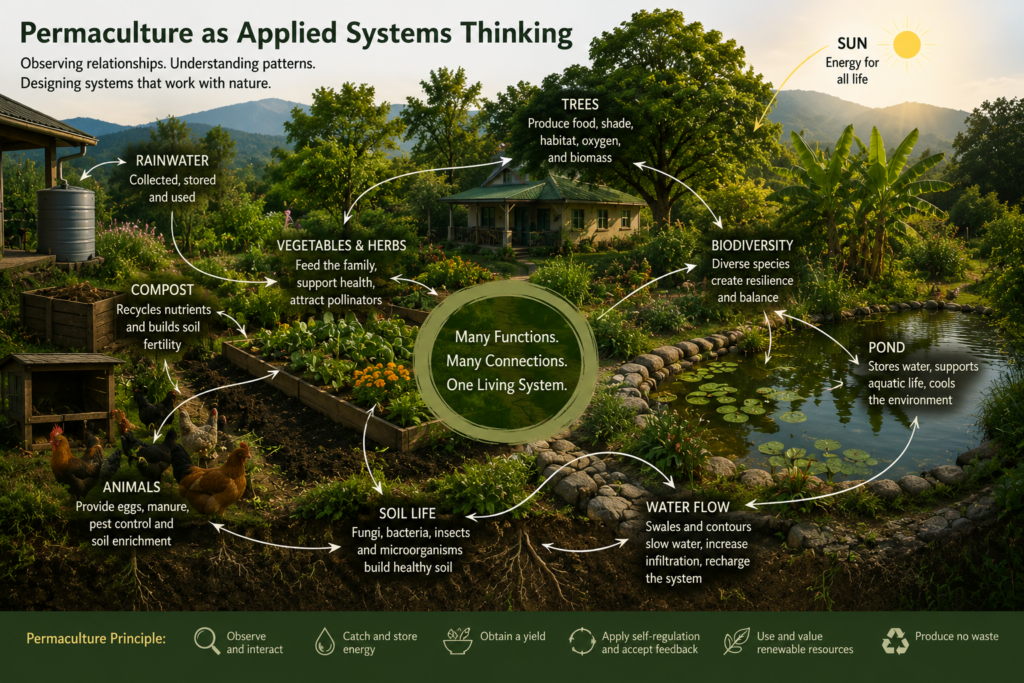
Permaculture therefore encourages designers to ask not simply, “What does this element do?” but rather, “How does this element strengthen the relationships within the whole system?” A garden becomes more than a place to grow vegetables. It becomes an ecosystem that supports biodiversity, conserves water, builds fertile soil, nourishes families, creates opportunities for learning, and strengthens community relationships.
This shift from objects to relationships lies at the heart of systems thinking.
Learning to See Relationships
One of the greatest transformations that systems thinking offers is teaching us to notice relationships that often remain invisible.
A pond, for example, is not simply a body of water. It stores rainfall during wet seasons, supports aquatic life, provides irrigation during dry periods, moderates local temperatures, attracts beneficial wildlife, reflects sunlight, and creates a peaceful environment for people. Every one of these functions interacts with many others.
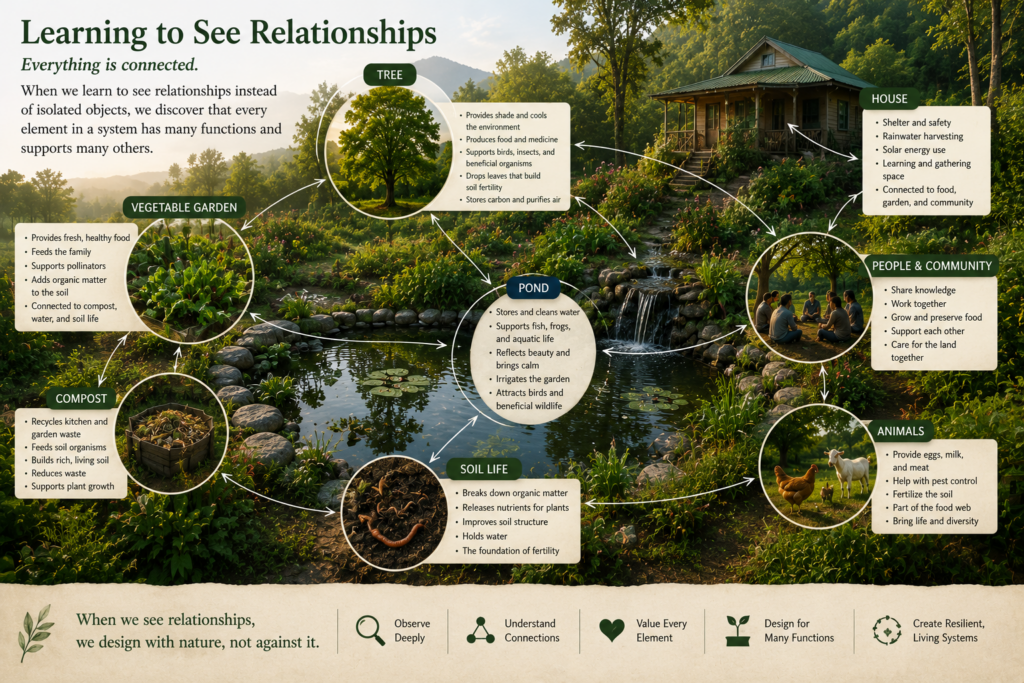
Similarly, healthy soil is far more than dirt beneath our feet. It is a living community of fungi, bacteria, insects, roots, organic matter, minerals, water, and air. The fertility of soil depends not upon a single ingredient but upon the health of countless biological relationships working together.
Nature constantly reminds us that nothing truly exists in isolation. Every organism influences and is influenced by the larger system around it.
Patterns Shape Our World
Systems thinking also encourages us to pay attention to patterns rather than isolated events. Individual events often appear random, but over time, recurring patterns reveal how systems actually behave.
In nature, rivers develop branching networks, leaves form repeating structures, coastlines display complex edges, and forests grow through cycles of succession. These patterns are not accidents; they emerge because living systems continually adapt to changing conditions.
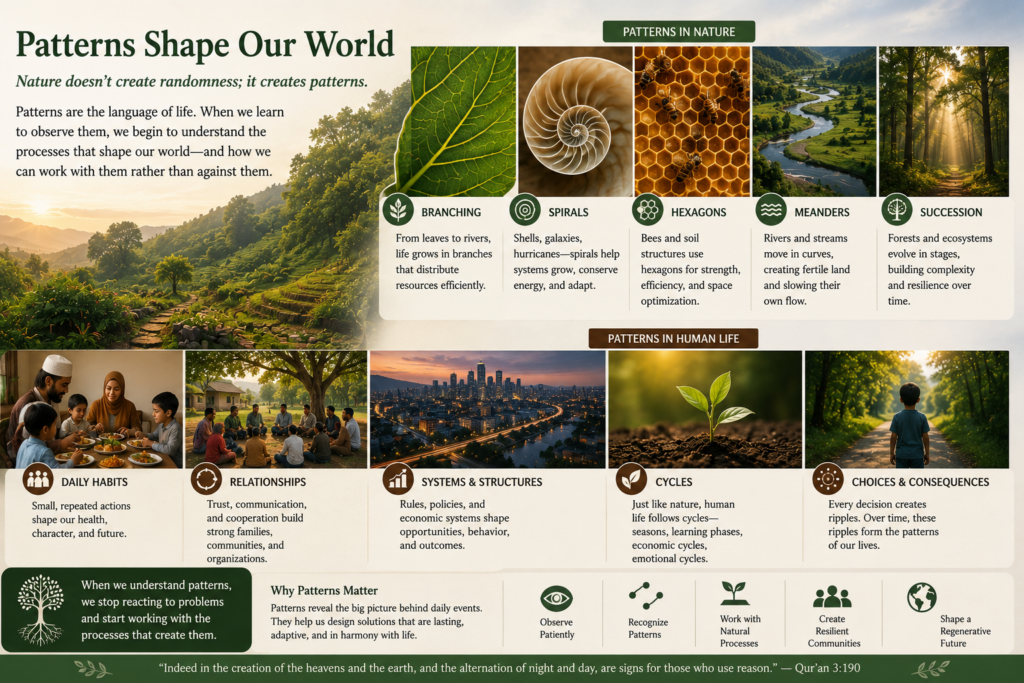
Human life follows similar principles. Daily habits gradually shape health. Communication patterns shape relationships. Community culture influences behaviour. Repeated decisions eventually become the future we experience.
Permaculture encourages careful observation before taking action because patterns reveal opportunities that individual events cannot. Instead of reacting to every immediate problem, systems thinking asks us to understand the larger processes that continue generating those problems.
Feedback and Continuous Learning
Every healthy system learns through feedback.
Nature constantly adjusts itself through countless feedback loops. Predator populations influence prey numbers. Rainfall affects vegetation, while vegetation influences water infiltration and local climate. Healthy ecosystems remain dynamic because they continuously respond to change.
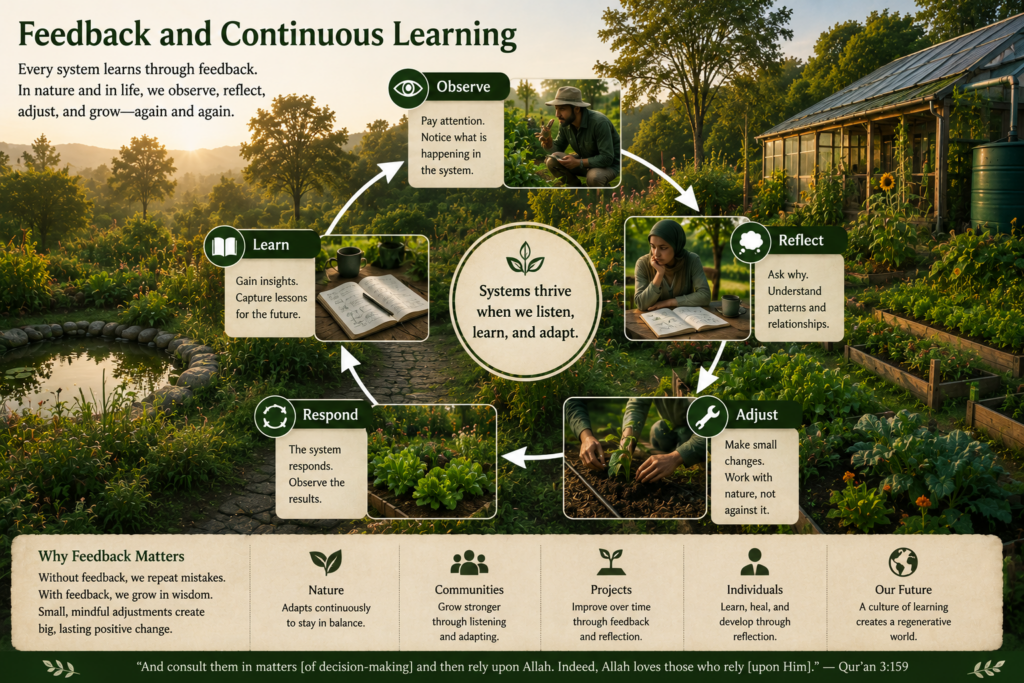
The same principle applies to human systems. Effective leaders listen carefully to feedback. Successful communities adapt when circumstances change. Individuals grow through reflection, learning, and experience rather than rigid certainty.
Permaculture embraces this reality through its emphasis on observation and gradual adjustment. No design is ever truly finished because every landscape continues to evolve. Good designers therefore become lifelong learners, allowing the living system itself to become their teacher.
Complexity and Humility
One of the greatest gifts of systems thinking is humility.
The more deeply we observe living systems, the more we recognise that they are far too complex to control completely. Every intervention creates consequences that extend beyond our immediate awareness. Actions intended to solve one problem may unintentionally create another if relationships are ignored.
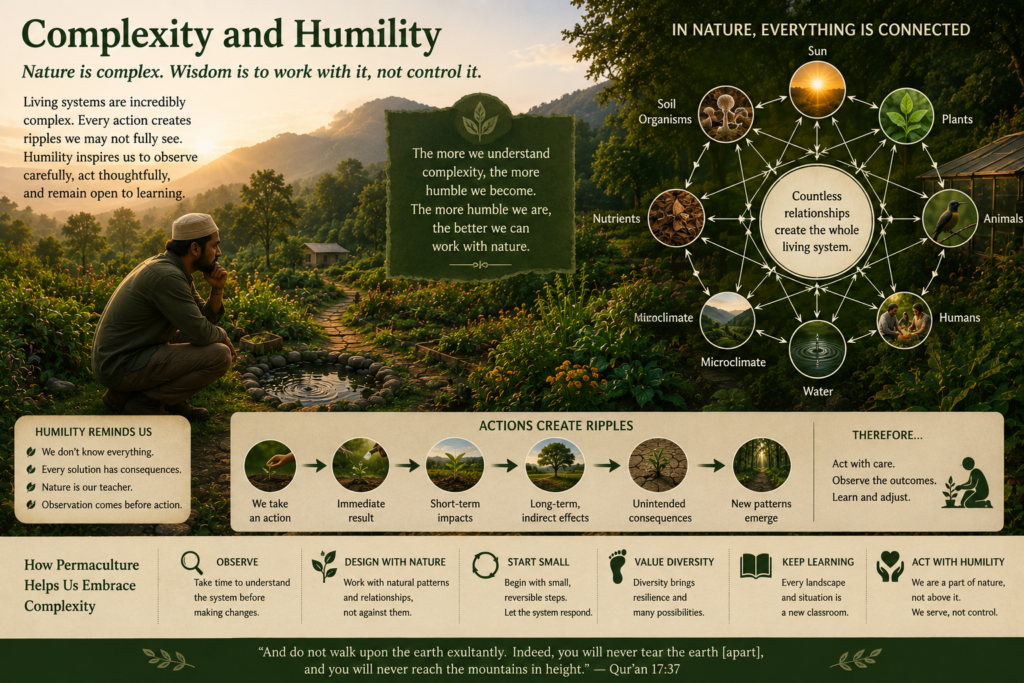
This does not mean we should avoid acting. Rather, it encourages us to act thoughtfully, observe, and remain willing to learn. Humility allows us to work with complexity instead of pretending to master it.
Nature rarely rewards arrogance, but it continually rewards careful observation.
Systems Thinking in Everyday Life
Although systems thinking emerged in many scientific disciplines and found practical expression through permaculture, it offers valuable insights for everyday living.
When we experience stress, for example, it is often tempting to search for a single cause. Yet our wellbeing is shaped by the interaction of many factors: sleep, nutrition, movement, meaningful work, supportive relationships, financial security, spiritual practices, exposure to nature, and the environments in which we spend our time. Improving one area while neglecting the others may provide temporary relief but rarely leads to lasting well-being.
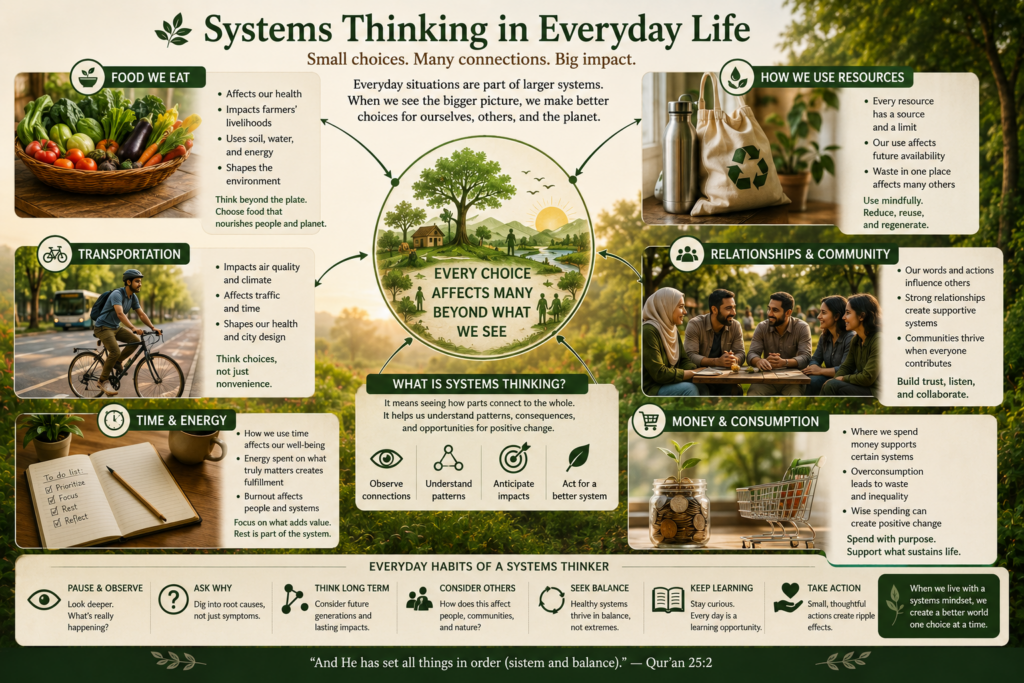
The same principle applies to families, organisations, and communities. Trust develops through repeated interactions rather than isolated events. Strong communities emerge when people invest consistently in relationships, shared purpose, and mutual care. Healthy societies, like healthy ecosystems, depend upon countless connections functioning together.
Once we begin to think systemically, we naturally ask different questions. Instead of searching for quick fixes, we seek a deeper understanding. Instead of asking what is broken, we ask which relationships need strengthening. Instead of reacting only to symptoms, we begin exploring the patterns that created them.
A Different Way of Seeing
Perhaps the greatest value of systems thinking is not that it provides new techniques but that it offers a new lens through which to view the world.

It reminds us that our lives are woven into larger systems that include our families, communities, economies, cultures, and the natural world. None of us exists independently of these relationships. Every decision we make influences something beyond ourselves, just as countless unseen relationships continually shape our own lives.
Permaculture introduced many people to this way of thinking, but its wisdom extends far beyond the garden. It invites us to slow down, observe, appreciate complexity, and recognise that lasting wellbeing grows from healthy relationships rather than isolated achievements.
Conclusion
Systems thinking challenges one of the deepest assumptions of modern life—the belief that we can understand reality by examining individual parts alone. Instead, it teaches us to see relationships, patterns, and interconnectedness as the true foundations of living systems.
Permaculture demonstrates this principle with remarkable clarity. By observing how nature organises itself, it shows that resilience, productivity, and regeneration emerge not from domination but from cooperation and balance. The lessons learned in a garden, therefore, become lessons for life itself.
As we face increasingly complex environmental, social, and personal challenges, the ability to think systemically becomes more valuable than ever. It encourages patience instead of haste, observation instead of assumption, and relationship instead of isolation.
Perhaps that is the deepest lesson nature offers us. When we learn to see the whole, we begin to understand that genuine flourishing is never created by individual parts alone. It emerges from the countless relationships that quietly sustain life every day.